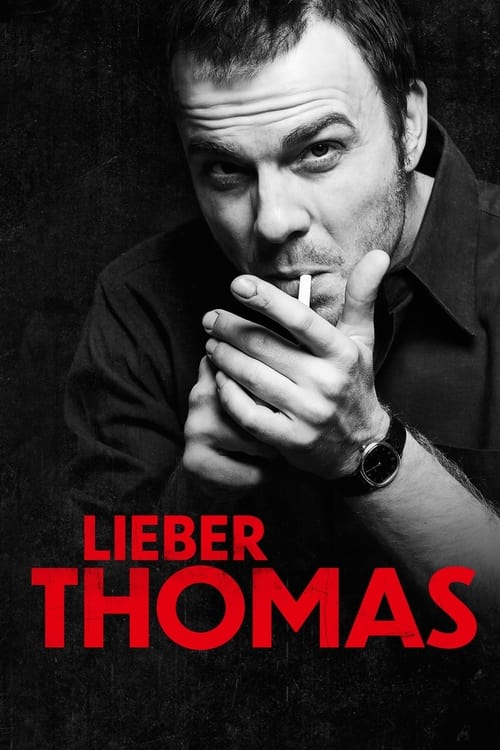
Dear Thomas
Plot
Thomas Brasch was born as a German-Jewish emigrant in England in order to move to the young GDR with his family at the beginning of the 1950s. His father Horst is primarily interested in helping to build the new German state. But Thomas prefers to realize himself as a writer and in doing so discovers his potential as a poetic rebel. His very first play was banned and soon afterwards he lost his place at the film school. When the tanks of the Soviet Union roll through the Czech capital Prague in 1968, Brasch and his girlfriend Sanda and other students try to call for protest in the streets of Berlin - and fail. His own father betrays him to the Stasi and allows Thomas to go to prison. After being paroled, he continues to try his hand at poet writing about love, revolt and death. In the GDR, however, you don't want to have anything to do with someone like him.
Get the Weekly Woke Watchlist
New and trending movies scored for woke bias, preachy messaging, and forced political themes — before you waste your evening.
No spam. One useful email per week.
Overall Series Review
Categorical Breakdown
The narrative is a purely ideological and personal conflict, centered on the struggle of a German dissident artist against a totalitarian state. Character merit (as a writer) is the sole focus of his life and conflict. There is no reliance on race, intersectional hierarchy, or vilification of 'whiteness.' Brasch’s German-Jewish heritage is part of the historical context of his family's return to the GDR, not a driver of modern identity politics within the plot.
The film’s central critique is directed at the communist GDR regime, a system and ideology that is historically and philosophically antithetical to core Western liberal values (liberty, free expression). The critique is of a totalitarian, anti-Western system, which, by the provided definition, does not constitute oikophobia. Brasch's general contempt for the GDR and his restlessness in the West indicate a universal non-belonging rather than specific hostility toward Western civilization itself, resulting in a low score.
The film is heavily male-centric, focusing on the male artist’s ego and genius. Female characters, including his romantic partners and muses, are noted in reviews as being secondary or 'props' for the male protagonist's story, with one scene depicting a naked woman as a literal writing surface. This character dynamic runs directly counter to the 'Girl Boss' and 'Mary Sue' tropes. While the women are not celebrated in a complementarian sense, the narrative structure is also not promoting the anti-natalist or female-perfectionist agenda of 10/10 woke Feminism.
The story focuses exclusively on the heterosexual male protagonist's life, political rebellion, and tumultuous relationships with women. There is no evidence of the centering of alternative sexualities, deconstruction of the nuclear family beyond the personal failure of the protagonist’s relationships, or any didactic messaging on gender ideology. The structure is normative and focused on the historical reality of the subject.
The film's primary conflict is political and artistic freedom versus the state (GDR Communism), which was an officially atheist/secular regime. The focus is on state repression, not hostility toward Christianity or traditional religion. Since the state itself is anti-religious and the protagonist's rebellion is secular-artistic, traditional faith is absent from the conflict, resulting in a very low score, though the moral universe is more secular than transcendent.
Get the Weekly Woke Watchlist
New and trending movies scored for woke bias, preachy messaging, and forced political themes — before you waste your evening.
No spam. One useful email per week.