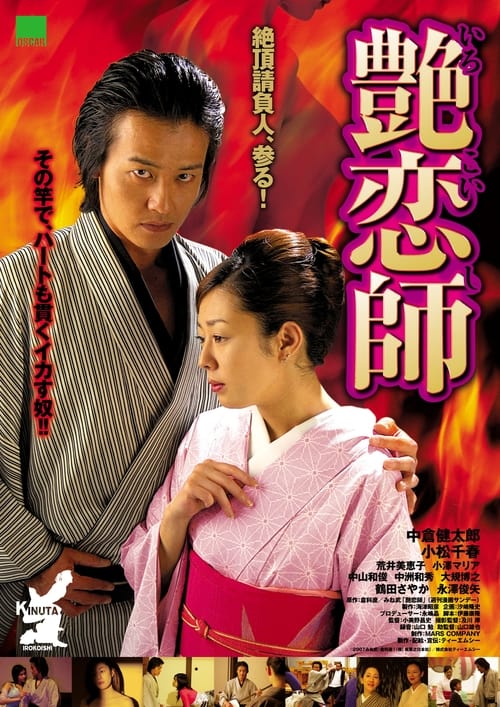
Love Master
Plot
Kikunosuke was born as a child outside marriage and raised by Tatsukichi, who is the female manager of Japanese traditional restaurant. Tatsukichi drills Kikunosuke hard in a Japanese traditional string instrument, Shamisen, and continence. However, Kikunosuke becomes a “man” by a Geisha, Botan when he turns 18, then he becomes a man who do sex for female and compensates for their unsatisfied physical and mental emptiness as his job, called “Saoshi (The rod master).” Also, he sets up for himself as a master of Shamisen. One day, a lonely club hostess, Nami, appears in front of Kikunosuke. Nami cannot get satisfied with sex and comes to Kikunosuke. He tried to make her happy with using various techniques, yet he gives up. With despaired and humiliated, Kikunosuke goes on a trip to become the best “Saoshi.” Then, Kikunosuke meets Yukino, has many struggles, at a bar, and he decides to sleep with Yukino. However, a mysterious man watching at them from outside.
Get the Weekly Woke Watchlist
New and trending movies scored for woke bias, preachy messaging, and forced political themes — before you waste your evening.
No spam. One useful email per week.
Overall Series Review
Categorical Breakdown
The movie is set in Japan with Japanese characters. The conflicts are entirely based on personal skill, professional merit (becoming the 'best Saoshi'), and social circumstance (illegitimate birth, the world of the geisha/ryotei). The narrative contains no elements of 'whiteness' vilification, forced diversity, or intersectional hierarchy as defined by the Western lens. Characters are judged solely by their competency and the content of their soul/intent.
The film is set within and explicitly incorporates elements of traditional Japanese culture, such as the Shamisen instrument, Geisha, and the Kagurazaka district, treating the aesthetic and the social structures as the authentic and romanticized setting. It documents the 'water world' (mizushobai) rather than framing the home culture as fundamentally corrupt or racist. There is no 'Noble Savage' trope or demonization of ancestors; it is centered on a specific, non-mainstream aspect of its own heritage.
The core plot is defined by a male protagonist whose entire life's work is 'to do sex for female and compensates for their unsatisfied physical and mental emptiness'. This structure subordinates the male role to the fulfillment of female physical and emotional needs. The narrative is noted for having an 'unusually feminist slant' by dedicating the hero to the 'greater erotic good of womankind'. This places a heavy focus on fixing female dissatisfaction and emasculates the male role by making his purpose entirely service-oriented, but stops short of depicting all men as bumbling idiots, as the hero is a 'master.'
The focus is on heterosexual relationships in an unconventional professional context (male sex worker and female clients). The narrative centers on a male-female pairing and sexual performance. There is no presentation or centering of alternative sexual ideologies, deconstruction of the nuclear family as a political concept, or explicit lecturing on gender theory. Sexuality is a profession in this context, but remains within a normative structure in terms of pairing.
The film operates in a completely secular space focused on art, commerce, and pleasure (Shamisen, *Saoshi*, *mizushobai*). There is no active hostility toward religion, specifically Christianity, as it is absent from the narrative. The morality is intrinsically subjective, based on physical and emotional satisfaction rather than a 'higher moral law,' creating a spiritual vacuum by omission rather than aggressive vilification. This pushes the score to a moderate level for its implicit moral relativism.
Get the Weekly Woke Watchlist
New and trending movies scored for woke bias, preachy messaging, and forced political themes — before you waste your evening.
No spam. One useful email per week.