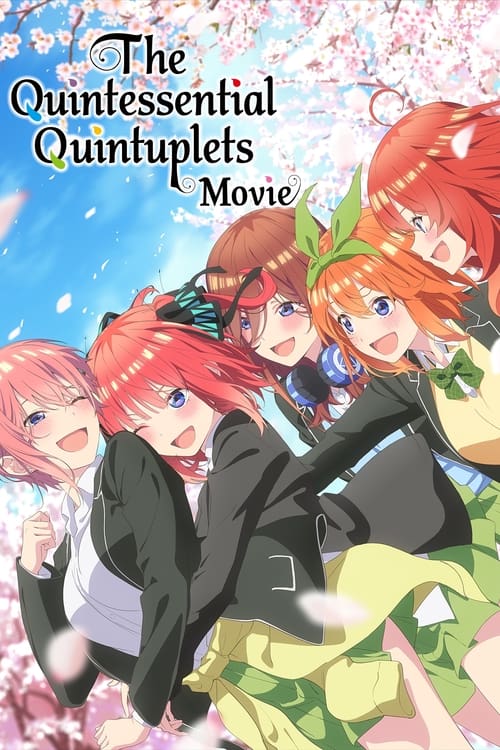
The Quintessential Quintuplets Movie
Plot
When five lovely young girls who hate studying hire part-time tutor Futaro, he guides not only their education but also their hearts. Time spent has brought them all closer, with feelings growing within the girls and Futaro. As they finish their third year of high school and their last school festival approaches, they set their sights on what’s next. Is there a future with one of them and Futaro?
Get the Weekly Woke Watchlist
New and trending movies scored for woke bias, preachy messaging, and forced political themes — before you waste your evening.
No spam. One useful email per week.
Overall Series Review
Categorical Breakdown
The plot centers entirely on character merit, personal growth, and emotional connection to determine the final pairing. All principal characters are ethnically Japanese, and the narrative does not rely on or mention any intersectional hierarchy, racial grievances, or vilification of any group.
The narrative is set within a contemporary Japanese high school and family context. The importance of the nuclear family and ancestral legacy, particularly concerning the quintuplets' mother, is a key emotional component. The ending is a traditional wedding, confirming a respect for foundational institutions.
The female characters are distinct and grow from being academic failures to independent individuals, and their arcs are focused on romantic love and culminating in marriage. While the central premise is a 'harem' where they are vying for a male lead, the core message is of their individual development. The male lead is a highly competent academic, and his masculinity is protective and helpful, not emasculated or toxic. Motherhood is shown as a positive element, and the story concludes with the celebration of a future wife.
The core of the movie's drama is the heterosexual choice of a bride from five sisters. The film’s focus is entirely on a traditional male-female pairing and the formation of a nuclear family, and it contains no presence of alternative sexual ideology, gender theory, or deconstruction of biological reality.
The plot is secular but is focused on transcendent moral choices, like self-sacrifice and making decisions that impact others. The final resolution of choosing a spouse emphasizes commitment, which is a traditionally moral and spiritual act. There is no hostility toward religion or promotion of moral relativism; the morality is driven by objective truth in relationships.
Get the Weekly Woke Watchlist
New and trending movies scored for woke bias, preachy messaging, and forced political themes — before you waste your evening.
No spam. One useful email per week.