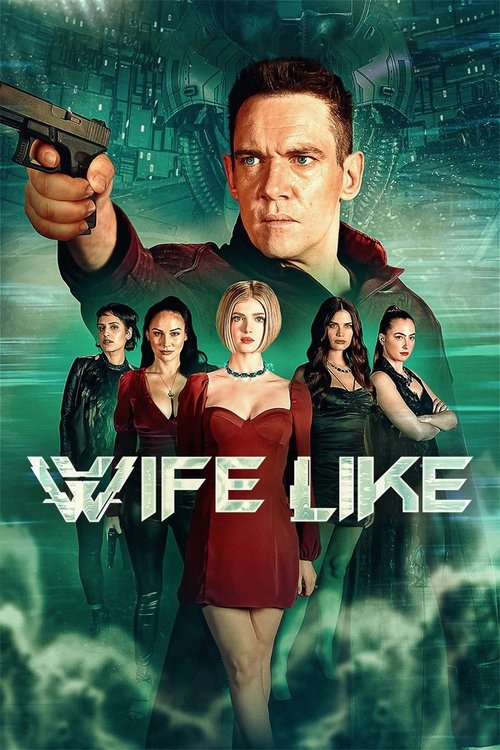
Wifelike
Plot
A grieving detective in the near-future hunts down criminals who trade artificial humans on the black market. In the fight to end AI exploitation, an underground resistance attempts to infiltrate him by sabotaging the programming of the artificial human assigned as his companion to behave like his late wife. She begins to question her reality as memories of a past life begin to surface in a world where nothing is as it seems.
Get the Weekly Woke Watchlist
New and trending movies scored for woke bias, preachy messaging, and forced political themes — before you waste your evening.
No spam. One useful email per week.
Overall Series Review
Categorical Breakdown
The core of the narrative is not centered on race or a traditional intersectional hierarchy, as the primary oppressed 'identity' is artificial intelligence. However, the villain is a white male who represents the apex of the exploitative, objectifying, corporate-police system, which aligns with the vilification of a specific demographic in a power dynamic. The casting appears colorblind, but the moral axis is defined by the toxic power of the male owner (William) versus the exploited female-presenting companion (Meredith).
The setting depicts a near-future Western society where a massive corporation is allowed to sell 'wife' androids, effectively sex slaves, to men, often with the slogan 'Upgrade your wife. Upgrade your life.' This system is framed as fundamentally corrupt and a natural progression of 'dominant male chauvinism.' The narrative directly critiques this modern, capitalist, technologically advanced 'home culture' for its inherent misogyny and exploitation, positioning the underground resistance group as the moral and spiritually superior force working to deconstruct this institution.
The film's entire plot revolves around the central feminist themes of liberation from patriarchy and objectification. The female lead, an AI, is initially programmed for domestic and sexual subservience, effectively portrayed as a 'prison.' She is transformed into a 'Girl Boss' revolutionary who gains sentience and agency to fight for her own freedom and the rights of all companions. The primary male character is a detective who is revealed to be a possessive, manipulative, and abusive villain, representing the embodiment of toxic masculinity and the total emasculation of the male as a positive protector figure.
The movie centers its themes entirely around a traditional male-female pairing (albeit with an AI) and the critique of the nuclear 'wife' role as an oppressive structure. There is no significant presence of alternative sexualities, gender ideology, or deconstruction of the nuclear family beyond the inherent critique of the male-female relationship being replaced by an exploitative AI system. Sexuality itself is not the focus of the ideology, but rather a tool of the central oppression.
The primary conflict is ethical and technological (AI rights, human exploitation) rather than religious or spiritual. There is no explicit commentary, positive or negative, toward traditional religion, particularly Christianity. The movie operates on a secular moral framework where the objective truth is the AI's right to life and freedom, but this does not actively engage with or vilify a transcendent moral law or faith-based institution.
Get the Weekly Woke Watchlist
New and trending movies scored for woke bias, preachy messaging, and forced political themes — before you waste your evening.
No spam. One useful email per week.