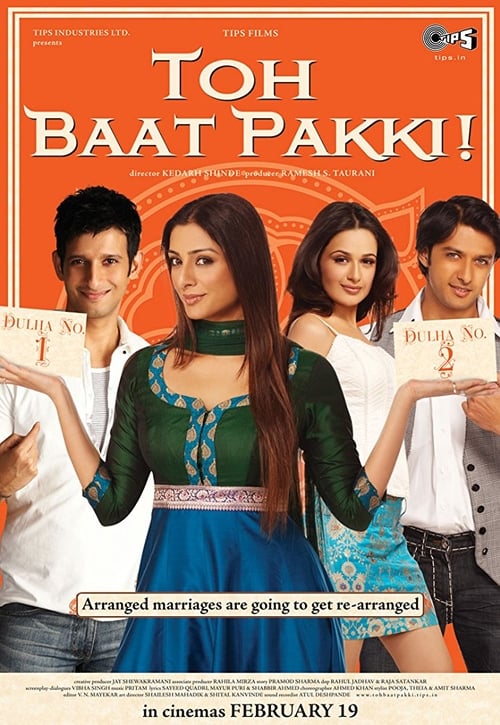
Toh Baat Pakki!
Plot
A pushy busybody invites a young man to be her tenant, in hopes of arranging a marriage for her younger sister; but then has to get rid off him when she believes she has found an even better match.
Get the Weekly Woke Watchlist
New and trending movies scored for woke bias, preachy messaging, and forced political themes — before you waste your evening.
No spam. One useful email per week.
Overall Series Review
Categorical Breakdown
The film focuses entirely on the internal dynamics of an Indian middle-class family from the Saxena community and their search for a financially 'suitable' groom. The conflict centers on class and economic status within this specific, non-Western context. There is no vilification of 'whiteness,' forced diversity, or reliance on intersectional hierarchy, as the cast and setting are culturally authentic to the story being told.
The movie is an Indian production set in a small Indian town and explicitly explores an Indian middle-class custom of arranged marriage and social climbing. The film's critique, if any, is of the materialism in the local matchmaking system, not a broader hostility toward its 'home culture.' There is no theme of civilizational self-hatred or a preference for external cultures as morally superior.
The core plot is pro-family and pro-natalist, revolving entirely around the effort to secure a traditional, heterosexual marriage for the younger sister. The lead female schemer is a married housewife who is a mother and whose ultimate goal is her sister's marriage, which celebrates the role of family. She is domineering and manipulative, which is a mild negative portrayal of a strong female lead, but this is a far cry from the 'Girl Boss' or 'Motherhood is a prison' tropes. The score remains low as the entire theme supports the institution of marriage and family.
The narrative is completely focused on the traditional pairing of a man and a woman in the context of marriage. The film's central dramatic device is the choice between two heterosexual male suitors for the female lead. The movie contains no elements of queer theory, deconstruction of the nuclear family, or focus on alternative sexualities or gender ideology.
The movie is a light romantic comedy focused on social and romantic conflict. The narrative is not concerned with religion, moral relativism, or objective truth. There is no hostility toward religious faith, and traditional morality surrounding marital fidelity and commitment is tacitly assumed as the foundation of the conflict.
Get the Weekly Woke Watchlist
New and trending movies scored for woke bias, preachy messaging, and forced political themes — before you waste your evening.
No spam. One useful email per week.