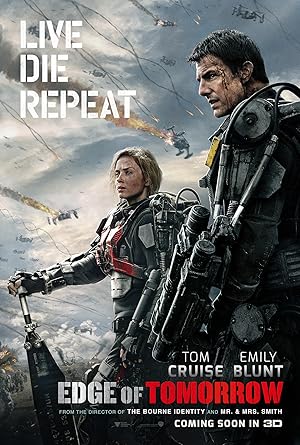
Edge of Tomorrow
Plot
An alien race has hit the Earth in an unrelenting assault, unbeatable by any military unit in the world. Major William Cage (Cruise) is an officer who has never seen a day of combat when he is unceremoniously dropped into what amounts to a suicide mission. Killed within minutes, Cage now finds himself inexplicably thrown into a time loop-forcing him to live out the same brutal combat over and over, fighting and dying again...and again. But with each battle, Cage becomes able to engage the adversaries with increasing skill, alongside Special Forces warrior Rita Vrataski (Blunt). And, as Cage and Vrataski take the fight to the aliens, each repeated encounter gets them one step closer to defeating the enemy!
Get the Weekly Woke Watchlist
New and trending movies scored for woke bias, preachy messaging, and forced political themes — before you waste your evening.
No spam. One useful email per week.
Overall Series Review
Categorical Breakdown
Characters are defined by their combat capability and moral development, not by immutable characteristics. Major Cage must earn his expertise through thousands of painful trial-and-error repetitions, illustrating a clear theme of merit and self-improvement. The human forces represent a unified global alliance facing an existential threat.
The plot centers on saving Earth and human civilization from destruction by an alien race, framing the entire effort as a defense of the home culture. The aliens are depicted as a purely hostile, destructive enemy.
Sergeant Rita Vrataski is the most competent combat soldier and the established war hero known as the 'Angel of Verdun'. She acts as the harsh instructor to the male lead, killing him many times to advance the mission. Her legendary status and immense capability are earned through her own traumatic time-loop experience, preventing her from being a 'Mary Sue'. The final relationship is a professional partnership where their distinct skills are complementary and essential for victory.
The narrative contains no presence of alternative sexual identities or gender ideology. The structure is based on the professional-romantic relationship that develops between the male and female lead, adhering to a normative structure.
The movie does not actively engage with religion. The central conflict and its solution are based on science-fiction mechanics, with the ethical discussions revolving around consequentialism and fatalism. Faith is neither presented as a source of strength nor is it vilified, remaining largely secular by omission.
Get the Weekly Woke Watchlist
New and trending movies scored for woke bias, preachy messaging, and forced political themes — before you waste your evening.
No spam. One useful email per week.