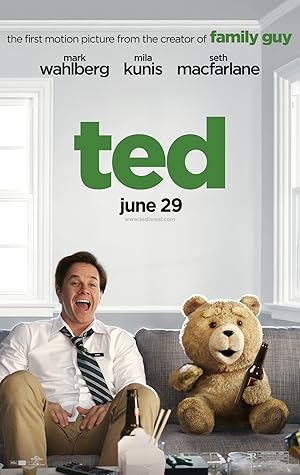
Ted
Plot
John makes a Christmas miracle happen by bringing his one and only friend to life, his teddy bear. The two grow up together and John must then choose to stay with his girlfriend or keep his friendship with his crude and extremely inappropriate teddy bear, Ted.
Get the Weekly Woke Watchlist
New and trending movies scored for woke bias, preachy messaging, and forced political themes — before you waste your evening.
No spam. One useful email per week.
Overall Series Review
Categorical Breakdown
The movie does not construct its narrative around an intersectional hierarchy; instead, the humor is broadly transgressive and indiscriminately mocks 'Jews, Christians, Muslims, African Americans, Caucasians, homosexuals, and celebrities.' The primary conflict is a personal one about maturity versus irresponsibility, not a systemic lecture on 'privilege.' Character is defined by immaturity or responsibility, not immutable characteristics.
The film's social commentary is a light satire aimed at a specific generation of men who are unable to let go of their childhood nostalgia and pop-culture obsessions, demonstrating 'arrested development.' The narrative's resolution is a move toward stability, responsibility, and the formation of a family unit, which directly counters the deconstruction of home and institutions.
Lori, the main female character, functions as the 'straight woman' and the voice of responsibility, compelling the male protagonist to abandon his immaturity for a stable future. John, the male lead, is depicted as an 'overgrown child' who is incompetent at adulting. However, Lori's goal is to achieve a stable relationship leading to marriage, which serves a complementarian function rather than a 'Girl Boss' mandate, and the story ultimately validates her desire for the nuclear structure.
Alternative sexualities are a target of the film's broad, crude humor, but the narrative does not center sexual identity as the most important trait. The film's core structure affirms the traditional male-female pairing as the desired end goal for the protagonist, with no didactic content or lecturing on gender theory.
The movie's humor is openly and explicitly hostile toward organized religion, with characters routinely mocking 'Christians, Jews, [and] Muslims.' The narrative is launched by a 'Christmas miracle' but immediately undercuts the sacred with a foul-mouthed, hedonistic teddy bear. Morality is consistently portrayed as subjective and based on crude indulgence, firmly rejecting a transcendent or higher moral law.
Get the Weekly Woke Watchlist
New and trending movies scored for woke bias, preachy messaging, and forced political themes — before you waste your evening.
No spam. One useful email per week.