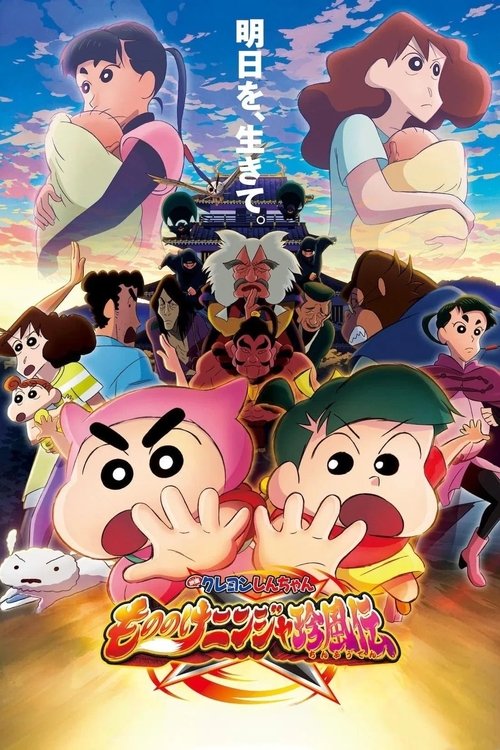
Crayon Shin-chan the Movie: The Tornado Legend of Ninja Mononoke
Plot
One day, a woman named Chiyome Hesogakure with a child named Chinzō visits the Nohara family and claims that she is the real mother of Shinnosuke and takes him away to a Ninja Village. In the Ninja Village, the Hesogakure family has been protecting "the earth's navel" by blocking it with a pure gold stopper using the "Mononoke technique" that has been passed down from generation. If it comes off, the earth will wither, the rotation will stop, and the "tomorrow" of the world will be lost! It is up to Shinnosuke to reveal the mystery of his birth and protect the future of the earth and the "tomorrow" of his family.
Get the Weekly Woke Watchlist
New and trending movies scored for woke bias, preachy messaging, and forced political themes — before you waste your evening.
No spam. One useful email per week.
Overall Series Review
Categorical Breakdown
Characters are judged entirely by their actions and the content of their soul, specifically their capacity for love and courage, rather than immutable characteristics. The core question is about family identity (Nohara vs. Hesogakure), not race or intersectional hierarchy. The Japanese setting and characters are historically and culturally authentic to the source material.
The narrative's central motivation is the protection of the traditional home (the Nohara family) and the world's 'tomorrow.' While the Ninja Village's ancient technique has a terrible side effect on its male members, this is framed as a sacrificial, ancestral burden that must be addressed, not an indictment of Japanese culture or heritage as fundamentally corrupt. The conclusion reaffirms the love and stability of the home institution.
The score is low because the mothers, Chiyome and Misae, are depicted as strong, capable, and fiercely protective of their children, with Chiyome's actions driven purely by the desire to save her child's future, a strongly natalist motivation. The men in the ninja lineage (Chinzo’s father and grandfather) are shown to have been permanently transformed into animals due to the ancestral technique, which presents a mild emasculation trope, but this consequence is due to a protective duty to the world, not incompetence, keeping the score low.
The story is entirely centered on the traditional male-female pairing of Hiroshi and Misae, and the central conflict is a defense of the nuclear family. There is no presence of alternative sexualities, gender ideology, or deconstruction of the normative family structure.
The conflict is centered on a fictional, ancient Japanese spiritual/magical concept (the earth's navel, Mononoke technique) and is not hostile toward any major world religion. The moral framework is objective, revolving around saving the world and protecting one's family, which reflects a transcendent moral law of duty and love.
Get the Weekly Woke Watchlist
New and trending movies scored for woke bias, preachy messaging, and forced political themes — before you waste your evening.
No spam. One useful email per week.