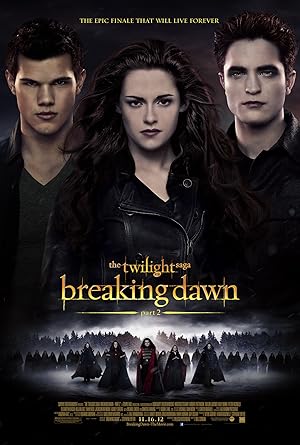
The Twilight Saga: Breaking Dawn - Part 2
Plot
The final Twilight Saga begins with Bella now a vampire learning to use her abilities. And happy to see her daughter, Renesmee is flourishing. But when someone sees Renesmee do something that makes them think that she was turned. This person goes to the Volturi, because it is a violation to turn a child. And the penalty is death for both who turned the child into a vampire and the child, cause they deem a turned child too dangerous. Alice gets a vision of the Volturi coming after them. So the Cullens try to convince them that Renesmee is not a threat. So they ask friends and family to come stand with them. But when someone who has it in for the Volturi shows up and tells them they should be ready for a fight. And they get ready.
Get the Weekly Woke Watchlist
New and trending movies scored for woke bias, preachy messaging, and forced political themes — before you waste your evening.
No spam. One useful email per week.
Overall Series Review
Categorical Breakdown
The narrative's central conflict is not based on race, but the peripheral characters involve race-based tropes, such as the portrayal of Native American werewolves as a 'Noble Savage' archetype. Foreign, non-white vampires are briefly showcased in costumes resembling 'tribal gear,' in contrast to the Western-dressed main white vampire coven, which frames them as exotic 'others.'
The film’s central theme is the fierce protection of the domestic family unit (the Cullens' coven) and their home in Forks against an external, authoritarian threat (the Volturi). The institution of the family is valued and viewed as a necessary shield for the characters' survival and happiness.
The female lead, Bella, instantly gains superhuman strength, abilities, and a fierce, unshakeable personality as a new vampire and mother. She is depicted as a 'Girl Boss' figure who is instantly perfect in her new role. However, the plot's ultimate goal is the sanctification of heterosexual marriage and the defense of motherhood and the nuclear family unit, directly opposing anti-natalist and traditional feminist viewpoints that critique these structures.
The core of the story is the protection of a traditional nuclear family (Edward, Bella, and Renesmee). The narrative is explicitly normative, reinforcing a traditional male-female pairing as the standard and culminating in a vision of their future as a complete family. Alternative sexualities or gender ideology are not present as central themes.
The plot's cosmology is built on a pagan and occult worldview where eternal life and 'salvation' are achieved through vampirism. Morality is purely subjective and founded on familial love and loyalty to the coven rather than a transcendent, objective moral law. The movie operates entirely outside a traditional Christian framework, presenting a secular/occult alternative to spiritual truth.
Get the Weekly Woke Watchlist
New and trending movies scored for woke bias, preachy messaging, and forced political themes — before you waste your evening.
No spam. One useful email per week.