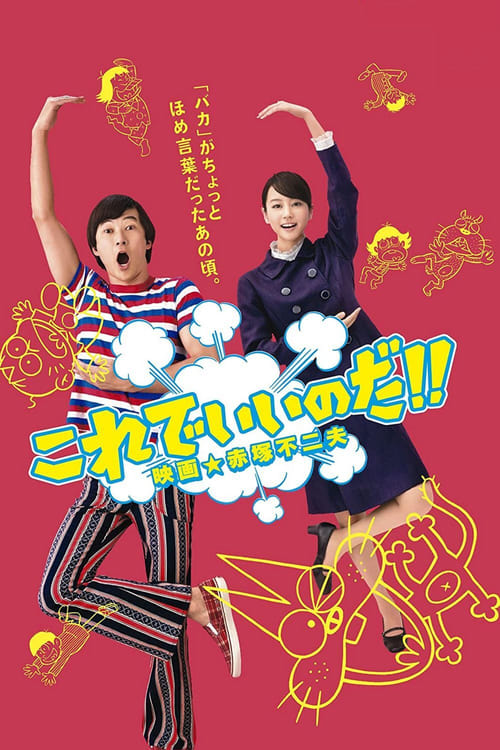
That's the Way!
Plot
A rookie editor Hatsumi Takeda becomes an editor of Fujio Akatsuka who is known as the king of gag manga. Hanging out with her, Akatsuka sees through Hatsumi's talent to be crazy, and they gradually become great partners...
Get the Weekly Woke Watchlist
New and trending movies scored for woke bias, preachy messaging, and forced political themes — before you waste your evening.
No spam. One useful email per week.
Overall Series Review
Categorical Breakdown
Characters are judged by their professional competence and personal 'talent to be crazy' rather than their race or immutable characteristics. The film is a biographical piece about a Japanese cultural figure and his Japanese editor, with no indication of race-based conflict, forced diversity, or vilification of any ethnic group.
The narrative is centered on celebrating a key figure in Japanese popular culture, the 'king of gag manga' Fujio Akatsuka, and a specific period of Japanese art and publishing. The movie appears to show gratitude for a national cultural institution, with no suggestion of civilizational self-hatred or demonization of the home culture or its ancestors.
The female protagonist, Hatsumi Takeda, is a rookie editor assigned to a male-dominated field who actively pursues professional success, initially wanting to publish 'female mangas.' Her arc involves shedding her 'refined' image and developing her own 'crazy' personality to become an effective editor, demonstrating a focus on earned professional merit and character development, not a 'perfect instantly' Mary Sue trope. The men are depicted as eccentric but successful, not as bumbling idiots.
The story is a professional drama set in the late 1960s Japanese publishing world. The plot focuses entirely on the working relationship between the manga artist and his editor. No characters or subplots are dedicated to alternative sexualities, the deconstruction of the nuclear family, or lecturing on gender theory.
The movie is a biography centered on the creative and professional life of a gag manga artist. It does not introduce or feature any discussion of religious doctrine, hostility toward Christianity or other faiths, or a debate on objective vs. subjective morality.
Get the Weekly Woke Watchlist
New and trending movies scored for woke bias, preachy messaging, and forced political themes — before you waste your evening.
No spam. One useful email per week.