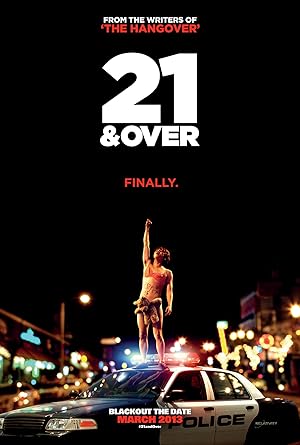
21 & Over
Plot
When Straight-A college student Jeff Chang's two best friends take him out for his 21st birthday on the night before an important medical school interview, what was supposed to be a quick beer becomes a night of humiliation, over indulgence and utter debauchery.
Get the Weekly Woke Watchlist
New and trending movies scored for woke bias, preachy messaging, and forced political themes — before you waste your evening.
No spam. One useful email per week.
Overall Series Review
Categorical Breakdown
The film does not lecture on systemic oppression or vilify whiteness; in fact, the two white friends are the protagonists. The movie uses crude, pre-woke humor that relies on and amplifies racial/ethnic stereotypes for comedy, such as the Asian 'Model Minority' stereotype and 'angry Latina sorority' trope. One of the white leads uses a racial slur toward the Asian lead early in the film, framing ethnicity as a basis for cheap jokes, not for political critique. The narrative sidelines the Asian character (Jeff Chang) for much of the running time by having him remain comatose, centering the two white males.
The conflict of the movie is the Asian lead choosing to pursue the hedonistic freedom of American college life, celebrating youthful independence, over the strict, traditional familial expectations of his father. The American setting, college, and Greek life are portrayed as a place of chaotic, but ultimately liberating, self-discovery.
The core of the movie is a 'bro-film' focused on male bonding and a quest to find Jeff Chang's address. Female characters exist primarily as sexual objects or plot devices, such as the 'sexually liberated sorority girls.' The movie is devoid of 'Girl Boss' tropes, anti-natalism, or any feminist lecturing, instead leaning into hyper-masculine, though often comically incompetent, male roles.
The primary dynamic is hyper-heterosexual pursuit, which runs counter to the Queer Theory lens. The movie uses 'same-sex snogging' and mentions of 'homophobia' as part of its general arsenal of crude and stereotypical humor, but it does not center alternative sexualities or promote gender ideology.
The movie is a secular college comedy focused exclusively on alcohol, partying, and personal freedom from family expectations. Traditional religion is simply absent from the narrative, neither being targeted for vilification nor used as a source of strength.
Get the Weekly Woke Watchlist
New and trending movies scored for woke bias, preachy messaging, and forced political themes — before you waste your evening.
No spam. One useful email per week.