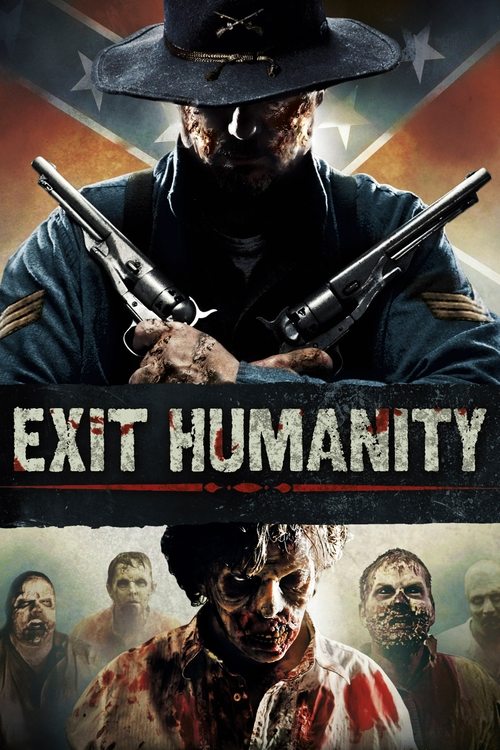
Exit Humanity
Plot
A decade after the American Civil War, Edward Young returns home from a hunting trip to find a horrific reanimation of his wife and that their son Adam has disappeared. He must battle his way through an unexplainable outbreak of the walking dead.
Get the Weekly Woke Watchlist
New and trending movies scored for woke bias, preachy messaging, and forced political themes — before you waste your evening.
No spam. One useful email per week.
Overall Series Review
Categorical Breakdown
The narrative centers on Edward Young's personal tragedy and his struggle to maintain his humanity. The primary villain, General Williams, is also a white male and a former Confederate general who is explicitly depicted as a symbol of 'depravity' and war-mongering, wanting to 'take back the South.' This frames the conflict as a moral battle between decency and evil within a specific historical/cultural failure, not a vilification of all 'whiteness' or a focus on racial hierarchy.
The central conflict involves a former Confederate General seeking to weaponize the plague to 'restore order' and 'win his war,' which is a direct critique of a specific, failed, and malevolent aspect of Western/American history. This villainy is not generalized to the entire culture. The protagonist's motivation is driven by an intense desire to honor his family and find a place of peace (his home/ancestral land), which demonstrates a strong attachment to the core institutions of family and place.
The plot's emotional core is Edward's profound love and grief over the loss of his wife and son, a direct celebration of the traditional family unit. The entire journey is motivated by this personal attachment. The female character Eve, representing 'decency,' is portrayed as a positive, non-hyper-sexualized figure, and the lead male, Edward, is shown to be emotionally complex and vulnerable, not a bumbling idiot.
The plot focuses entirely on themes of grief, spiritual survival, and the horrors of post-Civil War life and the zombie plague. No evidence exists of centering alternative sexualities, deconstructing the nuclear family, or including gender ideology lecturing. The structure remains normative by omission, focusing on universal human struggles.
The film is explicitly described as a battle for Edward's 'emotional and spiritual survival,' contrasting his inner humanity with the depravity of the antagonist. His journey is a transcendent quest for meaning and peace. The narrative highlights the importance of love and decency as a higher moral law, functioning as a source of strength against chaos, which directly aligns with transcendent morality.
Get the Weekly Woke Watchlist
New and trending movies scored for woke bias, preachy messaging, and forced political themes — before you waste your evening.
No spam. One useful email per week.