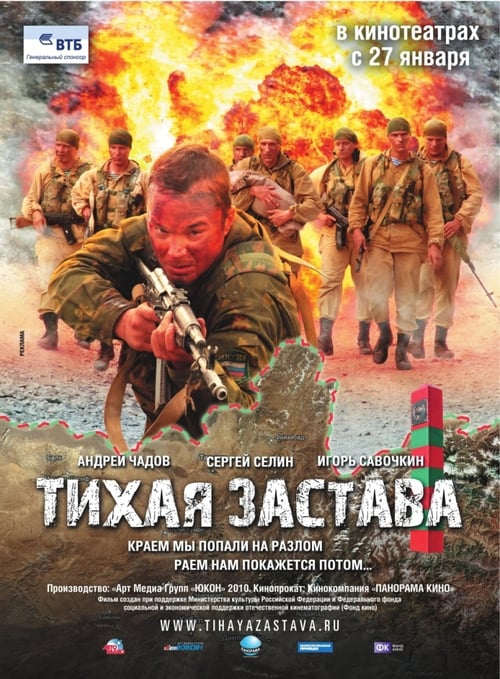
A Quiet Outpost
Plot
On the edge of Dushanbe, in the Republic of Tajikistan, a quiet border checkpoint under Russian control is attacked by Afghans and Tajiks who want it under their control.
Get the Weekly Woke Watchlist
New and trending movies scored for woke bias, preachy messaging, and forced political themes — before you waste your evening.
No spam. One useful email per week.
Overall Series Review
Categorical Breakdown
The film centers on Russian soldiers defending their border post from foreign militants, establishing a clear conflict based on national and ethnic identity, but the narrative does not lecture on systemic oppression or privilege. Characters, both Russian and local, are defined by their position in the conflict and military roles, not an intersectional hierarchy. The heroes are the Russian defenders.
The plot is the direct opposite of civilizational self-hatred, being a heroic story about the defense of a Russian-controlled outpost and the display of deep loyalty to the home nation and its military institutions. The entire premise is one of defending one's territory and respecting the sacrifice required for that defense.
Women occupy extremely secondary and traditional roles in the male-dominated military setting, primarily as emotional motivation or romantic interests for the male leads. The female characters are not developed as 'Girl Boss' figures and are even described as 'disposable' in one non-political subplot. Masculinity and protective duty are the central focus of the narrative.
The film contains no elements of alternative sexual ideology. The narrative is a straightforward, traditional war film focusing on combat and military life. The normative male-female structure, where it appears in secondary romantic subplots, is the unstated standard.
As a film focused on a conflict against religiously-motivated militants, the narrative frames traditional faith and duty as a source of strength for the Russian soldiers, implicitly contrasting their morality with the actions of the 'Islamic bandits' they fight. There is no vilification of traditional Western (specifically Russian Orthodox) religion or embrace of moral relativism; the soldiers' duty is framed as a higher, objective moral law.
Get the Weekly Woke Watchlist
New and trending movies scored for woke bias, preachy messaging, and forced political themes — before you waste your evening.
No spam. One useful email per week.