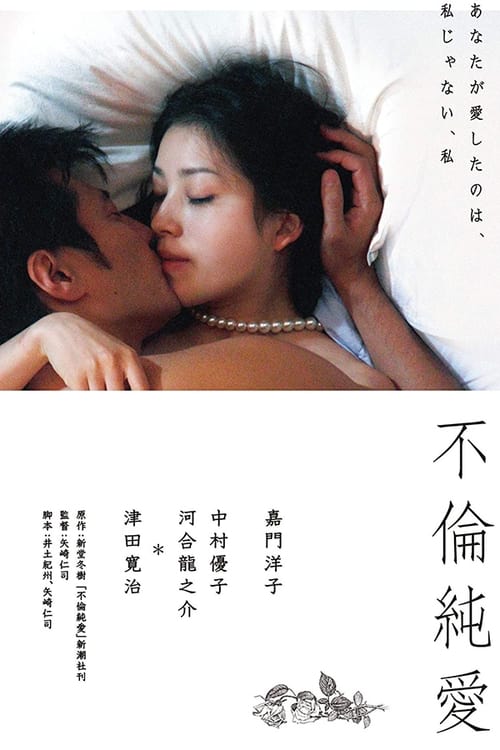
Love and Treachery
Plot
Kyosuke, an editor at a publishing company, keeps his concerns about his stagnant relationship with his wife hidden. As he struggles with his feelings, he meets Reika, the lover of an talented up-and-coming novelist, and becomes obsessed with her.
Get the Weekly Woke Watchlist
New and trending movies scored for woke bias, preachy messaging, and forced political themes — before you waste your evening.
No spam. One useful email per week.
Overall Series Review
Categorical Breakdown
The movie is a Japanese drama focused solely on the emotional and marital conflicts between Japanese characters. The conflict revolves around personal betrayal and infidelity, not immutable characteristics, race, or intersectional hierarchy. There is no political lecturing on privilege or forced insertion of diversity. Character judgment is based on individual moral failings and desire.
The film does not present a broad-stroke hostility toward Japanese civilization or heritage. The critique is directed at the specific institution of a stagnant, middle-class marriage and the emotional isolation within it. Characters are portrayed as emotionally detached or obsessed, and the narrative centers on universal themes of infidelity and passion, not the demonization of ancestors or home culture.
The wife, Machiko, is presented as an ‘exemplary wife’ who is neglected by her emotionally detached husband. Her subsequent affair and journey of ‘suspicion to intrigue’ is a direct response to a failed traditional dynamic. The movie critiques the institution of a long-term marriage as potentially suffocating to both men and women, with the narrative centering female pursuit of fulfillment outside the confines of the marital home, a form of anti-family messaging that scores toward the middle. However, the female characters are driven by complex and flawed emotions, not presented as 'Mary Sues.'
The narrative is strictly focused on heterosexual infidelity and the traditional pairing of male and female characters in marriage and affairs. Sexual identity is not a major theme or source of conflict. There is no presence of 'Queer Theory,' deconstruction of the nuclear family based on gender ideology, or political lecturing on alternative sexualities.
The film operates in a completely secular and morally relativistic universe. The dramatic conflict is driven entirely by human desire, emotional need, and betrayal, resulting in 'sinister hearts and white hot passion.' The narrative entirely embraces the idea of subjective morality, where characters act on personal, amoral impulse without a framework of transcendent morality, objective truth, or faith. Traditional religion is absent, and the vacuum is filled by base desire.
Get the Weekly Woke Watchlist
New and trending movies scored for woke bias, preachy messaging, and forced political themes — before you waste your evening.
No spam. One useful email per week.