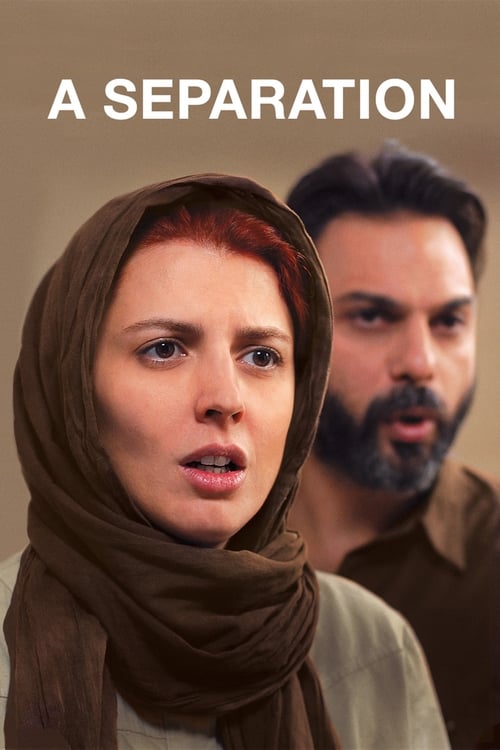
A Separation
Plot
A married couple are faced with a difficult decision - to improve the life of their child by moving to another country or to stay in Iran and look after a deteriorating parent who has Alzheimer's disease.
Get the Weekly Woke Watchlist
New and trending movies scored for woke bias, preachy messaging, and forced political themes — before you waste your evening.
No spam. One useful email per week.
Overall Series Review
Categorical Breakdown
The central conflict is driven by class and religious status, which functions as an intersectional lens within Iranian society. The narrative clearly portrays the middle-class family's advantages and how they often condescend to or oppress the struggling lower-class family, emphasizing systemic inequality based on socio-economic and traditional factors. The film does not, however, focus on Western-centric categories like race or 'whiteness' and is cast authentically to its setting.
The central dramatic impetus is the wife's desire to flee the home country, Iran, because she views the living conditions and overall future prospects as fundamentally flawed for her daughter. The story is an indictment of the country's social and legal institutions, particularly the theocratic elements, suggesting that home culture presents an intolerable choice between 'stay and suffocate or leave and be irrelevant.'
The narrative highlights the pervasive male dominance within Iranian culture and law. The wife's initial plea for divorce is belittled by the male magistrate, and a lower-class female character is shown to be legally prohibited from seeking employment without her husband's permission. The plot repeatedly showcases women's lack of autonomy and self-reliance, with the legal system shown to be restrictive and subordinating to women.
The film focuses exclusively on the breakdown and complexities of a traditional heterosexual marriage and family structures. The narrative does not feature or promote alternative sexualities, gender ideology, or a critique of the nuclear family outside of the context of a difficult divorce.
Religion, specifically institutionalized piety, is portrayed as a source of legal constraint, social complication, and individual hardship. The strict religious laws are shown to restrict the actions of the lower-class woman, which contributes to the legal tragedy. A secular character is shown to be willing to cynically manipulate the strong religious conscience of the pious character to save himself from legal trouble.
Get the Weekly Woke Watchlist
New and trending movies scored for woke bias, preachy messaging, and forced political themes — before you waste your evening.
No spam. One useful email per week.