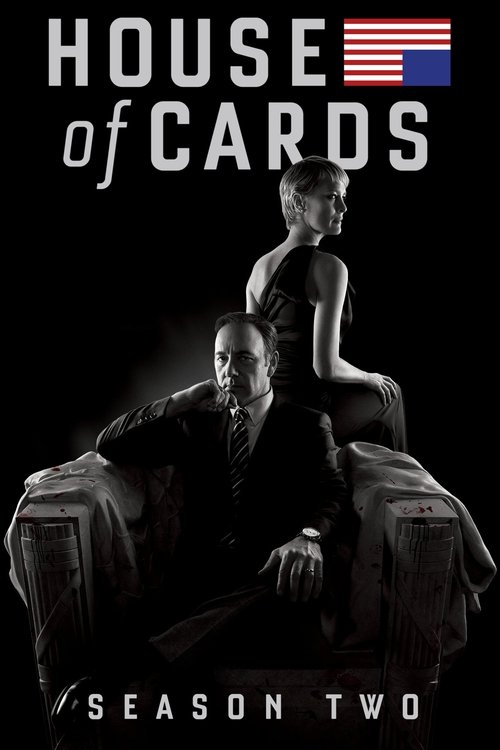
House of Cards
Season 2 Analysis
Season Overview
In their ruthless rise to power, Francis and Claire battle threats past and present, and form new alliances while old ones succumb to betrayal.
Season Review
Categorical Breakdown
The narrative universally adheres to a meritocracy of Machiavellian competence, where characters are judged only by their utility and ambition, regardless of race or sex. The central struggle is a raw power grab, not a lecture on systemic oppression or privilege. The diverse cast is placed into key positions based on their demonstrated ruthlessness and skill, which aligns with colorblind casting, albeit in a morally inverted world.
The show is a complete and intentional indictment of the home culture. It portrays American democracy and its institutions as fundamentally corrupt, easily manipulated, and wholly devoid of principle. The primary characters actively undermine, betray, and destroy the U.S. political system, reinforcing the idea that the entire civilization is a broken, amoral structure to be exploited by the powerful.
Claire Underwood is portrayed as the ultimate 'Girl Boss,' whose drive for career and power is explicitly pitted against the traditional feminine role of motherhood. She is cold, formidable, and ruthless, viewing procreation and family as a political hindrance. Her character explicitly states a willingness to sacrifice life for power, and she leverages her personal history, including multiple abortions, for political capital, framing anti-natalism as a key component of her empowerment.
Alternative sexualities are a normalized feature of the protagonist's life, with Frank Underwood engaging in a same-sex encounter as a casual element of his personal life, and a recurring character, Rachel, involved in a lesbian relationship. Sexuality is completely de-linked from normative structure and is centered as another private expression of the characters' amoral, transaction-based existence, which moves the needle toward a higher score due to its casual centering of non-normative sexuality in the main plot.
The entire philosophical underpinning of the show is moral relativism. The main characters operate on the doctrine that morality is subjective, and the only reality is 'power dynamics.' This explicitly mirrors the 10/10 definition, as the show champions a Nietzschean 'will to power' where objective truth and higher moral law do not exist. This lack of spiritual or moral constraint allows the central characters to justify all their evil deeds.