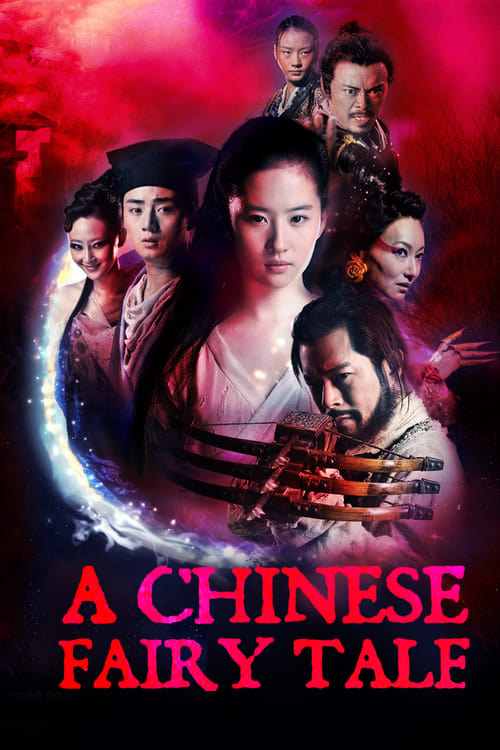
A Chinese Ghost Story
Plot
Government official Ling Choi Sin journeys to the parched Black Mountain Village, to help its inhabitants find water. As he leads a group of volunteers up the haunted mountain, he encounters a bevy of sexy demons as well as a lovely girl named Siu Sin. After wooing her with some candy, he falls for her... and then realises that he is caught in a deadly triangle; another guy, a demon-hunter named Yan Chek Ha is also in love with Siu Sin. However, before the two men can settle their differences, they have to contend with the evil Tree Demon as well as a one-armed demon hunter who is determined to kill all the supernatural beings.
Get the Weekly Woke Watchlist
New and trending movies scored for woke bias, preachy messaging, and forced political themes — before you waste your evening.
No spam. One useful email per week.
Overall Series Review
Categorical Breakdown
The film is an adaptation of a centuries-old Chinese story, featuring an entirely Chinese cast, and is set within ancient China. The casting is historically authentic to its source material. The central conflict is between humans (government official, demon hunters) and supernatural beings (demons), entirely bypassing any focus on race, intersectional characteristics, or the vilification of any specific human group like 'whiteness.' Character virtue is judged by their moral courage and compassion, not their immutable characteristics.
The film demonstrates no hostility toward its home culture. It is a faithful adaptation of a classic piece of Chinese literature, drawing heavily on Chinese mythology and spiritual concepts. The hero's initial purpose is to help the local village, showing a focus on civil duty. The demon-hunter defends the human realm and its people. Institutions and ancestors are not demonized; instead, the spiritual framework (Taoism) is presented as the primary tool for combating chaos and ancient evil (the Tree Demon).
Nie Xiaoqian, the female lead, is a powerful demon who is nevertheless forced into servitude and sexual exploitation by the monstrous, hermaphroditic Tree Demon (Laolao). Her arc is about finding liberation and love, and she displays subjective consciousness by defying her master. However, her final salvation requires the direct intervention of the two male leads, fitting the traditional damsel-in-distress trope of a ghost seeking mortal aid. Masculinity, embodied by the Demon Hunter, is protective, while the Tree Demon represents a predatory, non-maternal female form of power, leading to a low but not minimal score.
The core of the plot is a heterosexual love triangle: two men in love with the same woman, one of whom is a demon. The narrative exclusively focuses on this traditional male-female pairing, and the romantic bond is celebrated as a transcendent force. Sexual identity is not centered, and the nuclear family is not deconstructed or lectured against. The sexuality involved is part of the forbidden romance theme, not an ideological statement on alternative sexualities or gender theory.
Traditional religion, specifically Taoism, is depicted as the essential source of moral and physical strength necessary to fight evil. The Demon Hunter is a Taoist priest who wields spiritual power to protect humanity. The Tree Demon, an ancient, purely evil entity, is the source of chaos and immorality, representing an objective evil. The film operates within a clear framework of objective moral law and transcendent spiritual combat.
Get the Weekly Woke Watchlist
New and trending movies scored for woke bias, preachy messaging, and forced political themes — before you waste your evening.
No spam. One useful email per week.