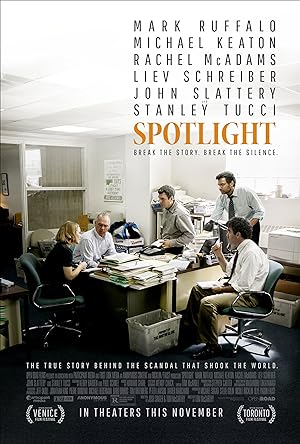
Spotlight
Plot
When the Boston Globe's tenacious "Spotlight" team of reporters delves into allegations of abuse in the Catholic Church, their year-long investigation uncovers a decades-long cover-up at the highest levels of Boston's religious, legal, and government establishment, touching off a wave of revelations around the world.
Get the Weekly Woke Watchlist
New and trending movies scored for woke bias, preachy messaging, and forced political themes — before you waste your evening.
No spam. One useful email per week.
Overall Series Review
Categorical Breakdown
The movie is a classic journalism procedural focused on professional merit and investigative skill. The team's diversity is minimal, reflecting the real people and setting, and the one notable 'outsider' character—the Jewish editor Marty Baron—is used to explain his lack of insular loyalty to the deeply Catholic local power structure, not to lecture on privilege. The film centers on exposing institutional corruption, not race or intersectional hierarchy.
The film launches a powerful critique against a core Western institution—the Catholic Church hierarchy—and the failure of a major American city's civic, legal, and community structures to address a systemic crime. This exposes fundamental corruption within the 'Western home culture.' However, the vehicle for correction is another core Western institution, the free press, which the movie honors as a shield against chaos by diligently pursuing objective truth, preventing a score for complete civilizational self-hatred.
The team includes a female reporter, Sacha Pfeiffer, who is portrayed as a competent, dedicated, and indispensable professional, a functional member of a complementary team of men and women. The procedural nature of the film keeps the focus on the work, avoiding subplots about her family life or anti-natalist messaging, and the male characters are depicted as professional and competent, not emasculated or bumbling.
The story is about child sexual abuse, a criminal matter of power and institutional failure. The film is careful to separate the crimes from sexual identity, explicitly noting that the abuse is about power and that homosexuality is beside the point. The victims are a diverse group of men and boys, and the narrative does not center on alternative sexualities, deconstruct the nuclear family, or engage in gender ideology lecturing.
The primary antagonist is a powerful religious institution, the Catholic Church hierarchy, which is exposed as corrupt and evil for its systemic cover-up of abuse. The critique is direct and unflinching on institutional complicity. However, the film avoids declaring traditional religion as the root of all evil, showing an ex-priest who maintains faith and distinguishes it from the Church's crimes, allowing a spiritual separation between the eternal and the corrupt institution.
Get the Weekly Woke Watchlist
New and trending movies scored for woke bias, preachy messaging, and forced political themes — before you waste your evening.
No spam. One useful email per week.