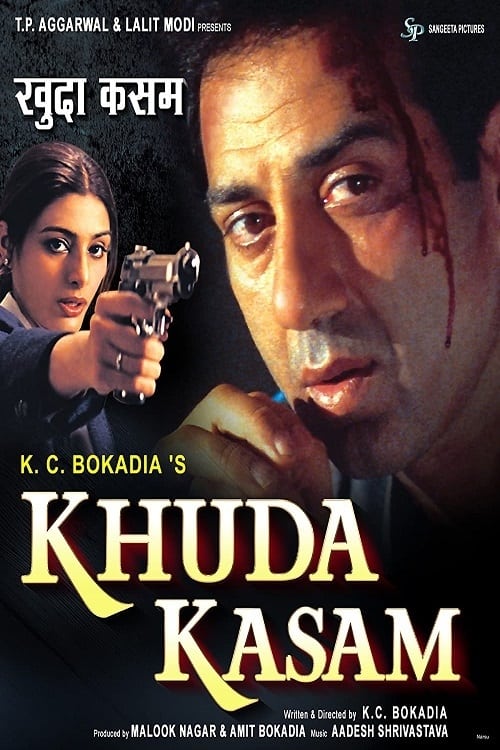
Khuda Kasam
Plot
Delhi-based CBI Captain Neetu Singh is instructed by Chief Sawant to investigate the assassination of Maharashtra's Chief Minister Satyaprakash. Her investigations will lead her to conclude that the killing was planned and carried out by Home Minister Bhavani Prasad Lala and Superintendent of Police Waghmare. She then meets with Fatima, and is told the story of the latter's son, Hussain, who was convicted for possession and supply of fire-arms and sentenced to five years in prison. She meets Hussain in prison and decides to assist him, but before she could do that she and her mother, Shanti, both end up on the defensive, when evidence surfaces that Neetu had hired a hit-man, Tatya, to kill Satyaprakash. The Judge hearing this incident finds her guilty and sentences her to prison.
Get the Weekly Woke Watchlist
New and trending movies scored for woke bias, preachy messaging, and forced political themes — before you waste your evening.
No spam. One useful email per week.
Overall Series Review
Categorical Breakdown
The narrative operates on universal meritocracy and moral alignment. The protagonists consist of a Hindu female officer and an honest Muslim man. The primary villain is a Hindu politician, Home Minister Bhavani Prasad Lala. The plot's core message actively rejects division, explicitly emphasizing that all individuals are 'Indian first,' making character and moral standing, not immutable characteristics, the basis for conflict.
The film's genre is listed as Patriotic and Social, with dialogue affirming national unity and the sacrifices of all communities for the country's freedom. Hostility is directed only toward corrupt individuals within political and police institutions, not the foundational home culture, ancestors, or the nation itself. Institutions are viewed as fundamentally good but temporarily polluted by bad actors.
CBI Captain Neetu Singh holds a powerful, high-status leadership role, aligning with the 'Girl Boss' trope. However, the character is later extensively victimized by male villains, including being framed, imprisoned, tortured, and assaulted. Her subsequent plan for revenge involves using a sexually manipulative disguise as a singer, complicating a purely empowered reading and showing a powerful woman defeated before having to fight back through deception. The male protagonist is not emasculated but acts as a complementary partner in the fight for justice.
The narrative does not center alternative sexualities, deconstruct the traditional nuclear family, or engage with gender ideology. The focus is exclusively on an action-drama plot concerning political corruption and justice, maintaining a normative structure.
The movie's title, 'Khuda Kasam' (By God), invokes the spiritual. The conflict is entirely political and social (corruption vs. justice), not religious or moral. Traditional faith elements appear as a cultural backdrop and a source of strength or consolation for characters, not as the root of evil. The morality presented is objective, valuing truth and justice against the corrupt state.
Get the Weekly Woke Watchlist
New and trending movies scored for woke bias, preachy messaging, and forced political themes — before you waste your evening.
No spam. One useful email per week.