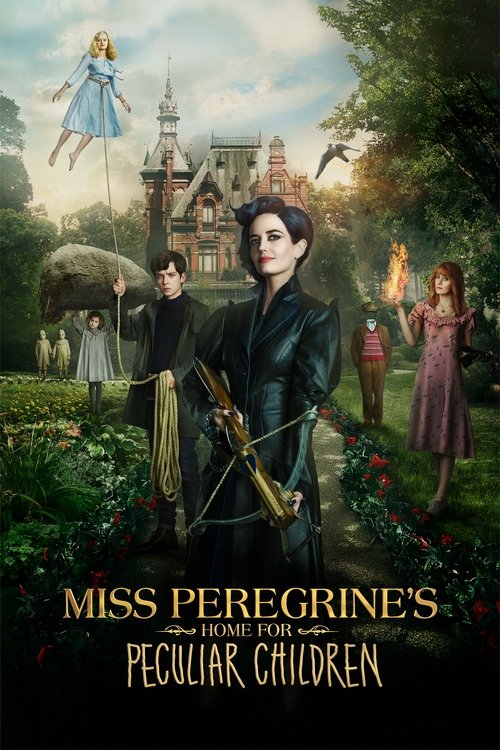
Miss Peregrine's Home for Peculiar Children
Plot
A teenager finds himself transported to an island where he must help protect a group of orphans with special powers from creatures intent on destroying them.
Get the Weekly Woke Watchlist
New and trending movies scored for woke bias, preachy messaging, and forced political themes — before you waste your evening.
No spam. One useful email per week.
Overall Series Review
Categorical Breakdown
The story centers on a white male protagonist who discovers his unique ability is the key to defeating the villain. The core group of peculiar children is visually homogenous and mostly white, with the main antagonist being the most prominent person of color, which is a structural element that works in opposition to modern intersectional mandates. Characters are defined by their special powers rather than their race or an intersectional hierarchy.
The central premise is the preservation of a home and a historical period (1943 Wales) from the chaos of the outside, modern world and a destructive historical event (WWII bomb). The world outside the time loop, representing modernity, is visually presented as dull and grey, while the sanctuary is vibrant and colorful. The narrative champions the traditional institution of a protected 'family' unit and the sacrifices of ancestors (like the grandfather) who maintained this refuge.
Miss Peregrine is a highly competent female leader and protector who manages the entire household, fitting the 'Girl Boss' archetype as a powerful, non-domestic matriarch. However, her primary function is a maternal-protective one for the children under her care. The main heroic arc and ultimate success in defeating the monsters still rely heavily on the unique ability and growth of the male protagonist, Jake, and the dynamic remains complementarian with both strong male and female roles.
The movie contains no discernible LGBTQ+ themes, representation, or exploration of gender ideology. The central romantic subplot involves a traditional male-female pairing between the protagonist and a peculiar girl, which reflects a normative structure.
The core conflict is a secular fantasy one involving supernatural abilities, time manipulation, and 'mad scientists' who become monsters through a failed experiment to achieve immortality. There is no explicit critique of Christianity or traditional religion, and no religious characters are depicted as villains or bigots. The morality, which involves protecting children from monster attacks, is clearly framed as an objective good versus evil struggle.
Get the Weekly Woke Watchlist
New and trending movies scored for woke bias, preachy messaging, and forced political themes — before you waste your evening.
No spam. One useful email per week.