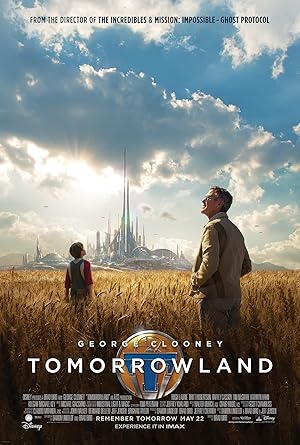
Tomorrowland
Plot
Bound by a shared destiny, a bright, optimistic teen bursting with scientific curiosity and a former boy-genius inventor jaded by disillusionment embark on a danger-filled mission to unearth the secrets of an enigmatic place somewhere in time and space that exists in their collective memory as "Tomorrowland."
Get the Weekly Woke Watchlist
New and trending movies scored for woke bias, preachy messaging, and forced political themes — before you waste your evening.
No spam. One useful email per week.
Overall Series Review
Categorical Breakdown
Characters are judged purely on the merit of their scientific curiosity and optimism, with the story focusing on the 'dreamers' and 'creators' regardless of their background. The primary conflict is ideological (hope versus despair), not based on race or intersectional status. The film selects the 'best and brightest' from all over the world, suggesting meritocracy is the organizing principle.
The current Earth civilization is condemned as a 'festering petri dish for indifference and complaints,' destined for an imminent, self-induced apocalypse due to its fatalism. Tomorrowland itself is a utopian society founded by a secret organization who deliberately abandoned the rest of humanity, seeking freedom from Earth's 'politics and bureaucracy, distractions, greed'. This frames the 'home culture' as fundamentally corrupt and unworthy of saving by its own merits, requiring intervention from an outside, superior elite who previously rejected it.
The main hero, Casey Newton, is a young female protagonist who is 'relentless' and possesses the 'can-do spirit' needed for salvation. The older male co-lead, Frank Walker, is portrayed as a 'jaded crank' whose primary character arc involves being inspired and saved from his despair by the capable heroine. Another central female character, Athena (an android), is depicted as the 'coolest, most logical mind' and the 'lynchpin' of the emotional story, while Frank is characterized as 'unhinged and uncontrolled'. This narrative strongly promotes the 'Girl Boss' trope at the expense of the male lead’s competence and agency.
No evidence appears in the film’s major themes or commentary of centering alternative sexualities, deconstructing the nuclear family, or promoting gender ideology. The focus is entirely on the science fiction adventure and the philosophical message of optimism.
The film presents a deeply secularized moral framework, replacing a transcendent moral law with the idea that humanity's fate is entirely up to its collective 'choice' of optimism or despair, framed as 'feeding the right wolf'. The apocalypse narrative is a material one (environmental, societal collapse) disconnected from religious eschatology, relying solely on human ingenuity and will to solve. Traditional religion is neither overtly villainized nor presented as a source of strength, effectively placing faith and morality in techno-humanism.
Get the Weekly Woke Watchlist
New and trending movies scored for woke bias, preachy messaging, and forced political themes — before you waste your evening.
No spam. One useful email per week.