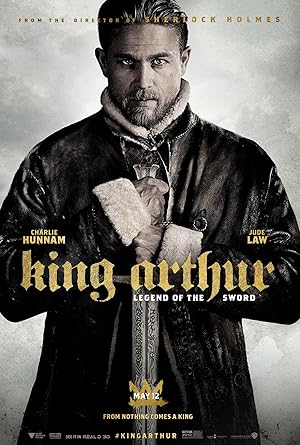
King Arthur: Legend of the Sword
Plot
An alternative version of the King Arthur legend. As a boy, Arthur is left orphaned after his father, King Uther Pendragon, and mother are killed in a war waged against them by Vortigern, who then assumes the throne. Arthur flees and is raised in a brothel, knowing very little of his birthright. Vortigern wants Arthur dead, to ensure there is no claimant to the throne. The legends foretell that only the next king will be able to draw Excalibur, Uther's sword, from the rock where it is lodged. So, in an effort to identify Arthur, Vortigern forces all the young men of Arthur's age to attempt to draw out the sword. Now it is Arthur's turn.
Get the Weekly Woke Watchlist
New and trending movies scored for woke bias, preachy messaging, and forced political themes — before you waste your evening.
No spam. One useful email per week.
Overall Series Review
Categorical Breakdown
The film intentionally employs significant 'race-swapping' for key roles like Sir Bedivere and other allies, establishing a multiracial 'resistance' crew against a white male tyrant, Vortigern. Vortigern’s authoritarian regime is visually depicted using imagery that evokes fascism, framing the fight as a diverse coalition against a white despot. This narrative structure and deliberate non-traditional casting prioritize diversity over historical or legendary authenticity.
The existing institutional power structure of the kingdom is depicted as utterly corrupt and evil, led by the tyrannical, murderous uncle. This deconstructs the traditional noble ideal of British/Western heritage by framing the established monarchy as a fascist entity that must be overthrown from the street level. Arthur's ultimate goal is the *restoration* of the kingdom, which prevents a full demonization of the home culture itself, but the current state of the realm is vilified.
The main female character, a powerful Mage who replaces Merlin, has a high degree of magical competence. However, she is an unnamed character who is eventually captured and used as leverage to motivate the male protagonist, effectively positioning the powerful female as a damsel-in-distress. Arthur is raised by the women of a brothel, which is a non-traditional family structure, but the women are portrayed with warmth as a loving, protective surrogate family, not as anti-natalist or anti-male figures.
The narrative focuses on a heterosexual male hero's journey, male-to-male camaraderie, and a traditional Good versus Evil conflict. There is no presence of alternative sexual ideologies, centering of non-normative gender identity, or deconstruction of the nuclear family through a queer theory lens.
The core moral conflict is a transcendent, objective battle between Good (Arthur's destiny) and Evil (Vortigern's tyranny). The spiritual and magical elements of the world—sea witches, the Lady of the Lake, The Mage, Excalibur—are purely pagan fantasy elements, not traditional Christianity. There is no open vilification of a traditional faith, but the central mythology of the hero is secularized and replaced entirely by sorcery and fate, side-stepping the Christian influences found in many Arthurian legends.
Get the Weekly Woke Watchlist
New and trending movies scored for woke bias, preachy messaging, and forced political themes — before you waste your evening.
No spam. One useful email per week.