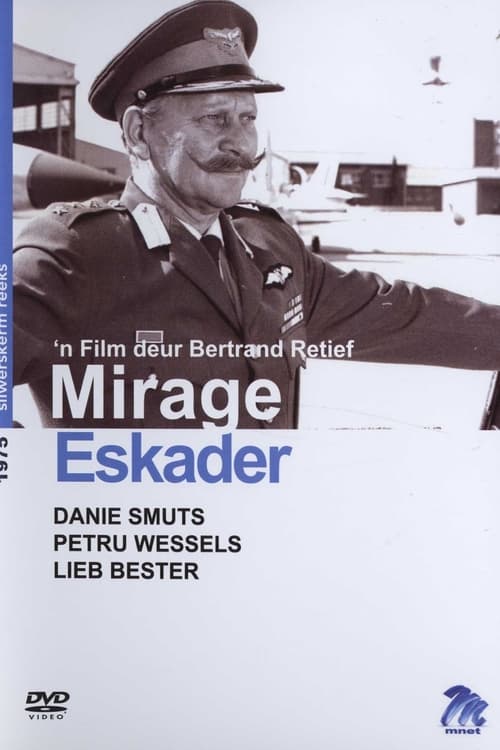
Mirage Eskader
Plot
Lt. Gerhard Muller is the son of a pilot who was killed while flying with the South African Air Force in Korea. At the time his best friend and fellow pilot, Chris Fourie, was the only one to return from their mission and since then there have been various rumours about what happened. Now Gerhard is joining a Mirage squadron at Waterkloof Air Force Base, where Fourie will be his immediate superior. In addition his grandfather, Colonel Greeff, is the base commander. Also joining the squadron is Gerhard's best friend, Martin Bekker, who is the only one who knows about Gerhard's recent dizzy spells. It also emerges that there was a relationship between Gerhard's mother and Commander Fourie before she and his father got married... The film is a fairly straightforward melodrama, with some nice flying sequences. Only towards the end do the pilots see action, when they are required to support ground troops repelling invading "terrorist" forces. Not surprisingly, the film is dedicated to the South African Air Force.
Get the Weekly Woke Watchlist
New and trending movies scored for woke bias, preachy messaging, and forced political themes — before you waste your evening.
No spam. One useful email per week.
Overall Series Review
Categorical Breakdown
The movie is set within and dedicated to the Apartheid-era South African Air Force, a hyper-specific, all-white institution. The plot celebrates the courage and duty of this demographic. Character merit is judged by performance as a fighter pilot and adherence to military/family honor, not by intersectional characteristics. There is no forced diversity, race-swapping, or vilification of 'whiteness'.
The film is an explicit piece of military propaganda, directly aiming to 'boost the image of the military' and is dedicated to the South African Air Force. The military is framed as a shield against external threats, repelling 'invading "terrorist" forces.' The narrative fully endorses and celebrates the institutions of the home culture and nation, showing gratitude and respect for its defense structure.
The core dramatic tension involves a male pilot, his male superior, his male grandfather (the base commander), and his male best friend. Women, specifically the protagonist’s mother, function as a source of domestic melodrama and a family secret from the past that complicates the men's professional relationship. The narrative celebrates traditional masculinity, military service, and duty; there are no 'Girl Boss' tropes or anti-natalist messages.
The narrative's central structure is the normative relationship between a son and his parents, albeit complicated by a past heterosexual affair. The film contains a single male-female pairing as the standard and focuses on military/family drama. There is no centering of alternative sexualities, deconstruction of the nuclear family beyond standard melodrama, or discussion of gender ideology.
The film's focus on duty, military honor, and defense of the nation is implicitly aligned with a conservative, transcendent moral structure. There is no presentation of traditional religion (in this context, likely Christianity) as evil or characters as bigots. Morality is framed as objective: the defense of the nation is a just cause, suggesting an objective moral truth.
Get the Weekly Woke Watchlist
New and trending movies scored for woke bias, preachy messaging, and forced political themes — before you waste your evening.
No spam. One useful email per week.