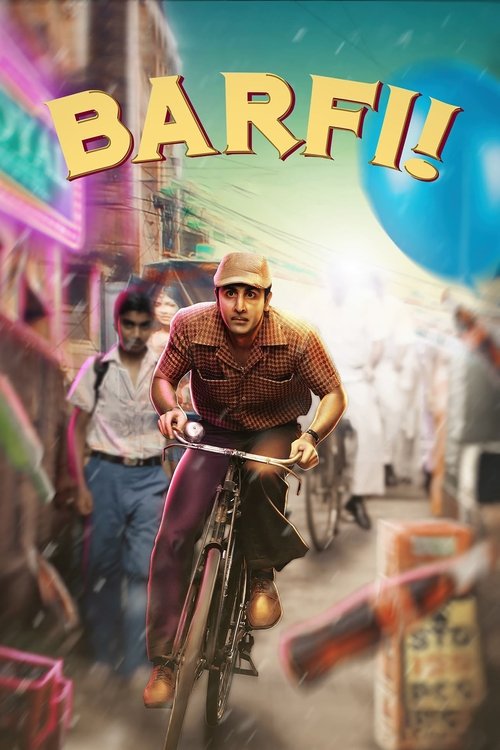
Barfi!
Plot
The heartwarming tale of Barfi, a charming deaf-mute young man from 1970s Darjeeling, and two unalike women who can't help but fall for him.
Get the Weekly Woke Watchlist
New and trending movies scored for woke bias, preachy messaging, and forced political themes — before you waste your evening.
No spam. One useful email per week.
Overall Series Review
Categorical Breakdown
The narrative centers on two characters with severe disabilities: Barfi (deaf-mute) and Jhilmil (autistic). The film’s focus is entirely on their character, charm, and universal capacity for love, not on using their marginalized status for political lecturing or demanding 'recognition' from an 'oppressive' system. Characters are judged strictly by the content of their soul and actions. The primary axis of conflict for Barfi is his lack of wealth, an economic barrier, rather than immutable characteristics like race or caste. This is a pure meritocracy of character.
The movie is set in Darjeeling and Kolkata in the 1970s, celebrating the charming simplicity and life of the local community. The setting, music, and atmosphere evoke a nostalgic and affectionate view of the Indian home and culture. Institutions like the family are respected, though Shruti's mother's focus on a stable, wealthy marriage over love is presented as a personal moral flaw, not a condemnation of the entire civilization. No hostility toward home culture or ancestors is evident.
The female characters, Jhilmil and Shruti, are complex, flawed, and vital to the story without adhering to the 'Girl Boss' trope. Jhilmil's autism makes her explicitly not a 'perfect' female lead, and her vulnerability highlights Barfi's protective, traditional masculinity. Shruti's choice to abandon Barfi for a marriage of security is framed as a regretful, tragic mistake, not a career-first triumph. Masculinity is protective and celebrated, and the relationships are rooted in sacrificial love.
The movie contains no overt LGBTQ+ themes, characters, or ideological commentary. The entire romantic focus is on the traditional, nuclear, male-female pairing, albeit with individuals who have non-normative disabilities. Sexuality and gender identity are not points of discussion or political focus, maintaining a normative structure where romance is treated as private and a natural part of life.
The core themes are transcendent love, sacrifice, and the inherent goodness of the human spirit, which function as an acknowledgment of an objective, higher moral law. The film’s spirit of pure, unconditional love between Barfi and Jhilmil serves as a spiritual counterpoint to the materialistic concerns of other characters. There is no depiction of traditional religion as a root of evil, nor is moral relativism promoted.
Get the Weekly Woke Watchlist
New and trending movies scored for woke bias, preachy messaging, and forced political themes — before you waste your evening.
No spam. One useful email per week.