Black Mirror
Season 4 Analysis
Season Overview
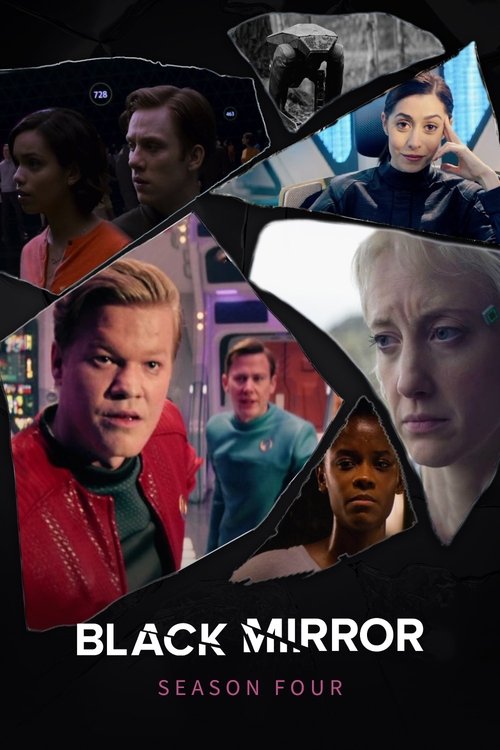
A fantasy spins out of control, all-seeing devices expose dark secrets, and a woman flees a ruthless hunter in more tales of technology run wild.
Season Review
Categorical Breakdown
The narrative of 'USS Callister' features a brilliant woman of color who rallies a diverse crew to overthrow her incompetent and tyrannical white male boss who uses his technology to enslave his employees. This frames a powerful narrative of a marginalized group defeating a figure of white male privilege. 'Black Museum' concludes with a young woman of color delivering justified, fiery revenge on an evil, exploiting white male torturer. Casting is diverse, and the show utilizes power dynamics rooted in immutable characteristics to drive the primary conflict.
The series' fundamental critique is focused on the moral degradation and anxiety of modern society, driven by its new technologies like social media, surveillance, and data harvesting. This is a pointed and systemic deconstruction of present-day norms and institutions. The season does not, however, focus on demonizing historical Western ancestors or deconstructing ancient heritage. It critiques current civilization rather than ancestral heritage.
Every episode in the season features a female main character. In 'USS Callister,' the female lead is instantly the most competent character, formulating the entire plan to escape from the weak male villain, embodying the 'Girl Boss' trope. 'Crocodile' and 'Arkangel' feature complex women driven to extreme acts—one a successful businesswoman turned serial killer, the other a mother who destroys her daughter's life through over-protection. Masculinity is often depicted as either toxic, pathetic, or utterly absent from the protection role.
The core relationships presented are primarily heterosexual, even when technology complicates them, such as in 'Hang the DJ.' The female lead in 'Hang the DJ' is presented as bisexual in her dating profile history, but this characteristic is not central to the main plot, which focuses on her bond with a male love interest. The nuclear family structure is not a central target for deconstruction in this season's plots, which focus more on individual technological isolation.
Traditional religion is conspicuously absent from the narrative world of the season, avoiding overt anti-Christian vilification. However, the foundational theme is a spiritual vacuum where the characters operate without objective moral constraints. Technology consistently exposes humanity's corrupt nature, and the narratives often conclude in bleak, nihilistic terms, suggesting a world devoid of transcendent moral law where self-interest and power dynamics are the only true forces.