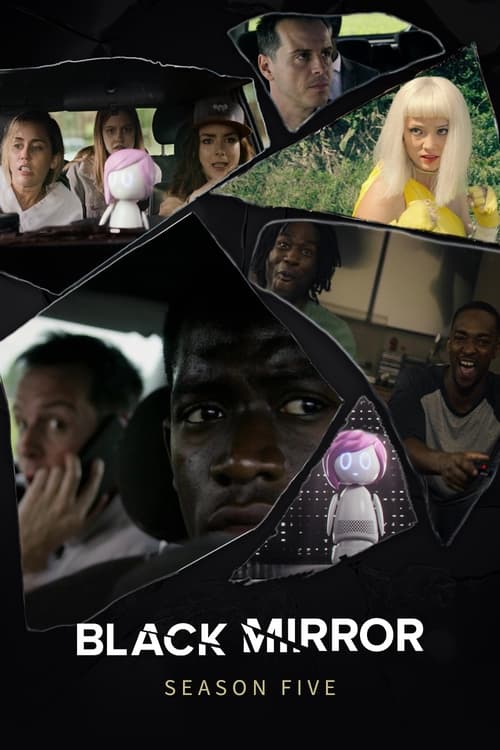
Black Mirror
Season 5 Analysis
Season Overview
A video game transforms a longtime friendship, a social media company faces a hostage crisis, and a teen bonds with an AI version of her pop star idol.
Season Review
Categorical Breakdown
The narrative's central conflicts are universal, focusing on technology, relationships, and celebrity exploitation, not systemic oppression or racial privilege. The casting features non-white leads in 'Striking Vipers,' but their race is incidental to the story's theme of sexual/virtual identity, suggesting a colorblind approach to the core story. No character is vilified based on their immutable characteristics.
The season contains a clear hostility toward modern Western institutions, particularly the Silicon Valley/Big Tech sector and the commercialized pop music industry. 'Smithereens' and 'Rachel, Jack and Ashley Too' strongly indict this contemporary Western 'home culture' for its nihilism and exploitation, but the critique remains focused on modern technology's ill effects rather than a demonization of ancient ancestors or a romanticizing of non-Western cultures.
'Striking Vipers' portrays the nuclear family as a source of malaise, concluding with the wife establishing an arrangement that allows her husband to pursue his non-traditional virtual 'affair' while she gets a night of personal escape, showing a deconstruction of traditional marital roles. The female lead in 'Rachel, Jack and Ashley Too' is a distressed celebrity who is rescued, not a 'Girl Boss' who is instantly perfect, but the antagonist is a hyper-controlling female corporate manager, presenting a mixed view of gender dynamics and power.
The episode 'Striking Vipers' is a high-intensity study of sexual ideology, using technology to explicitly deconstruct the boundaries of sexual and gender identity. Two ostensibly heterosexual men engage in a fully immersive, emotional, and sexual relationship via opposite-sex avatars, directly exploring the 'fluidity' of these labels and the performance of self, culminating in a permanent, non-traditional arrangement for the married protagonist.
The moral framework is consistently subjective and nihilistic. 'Smithereens' critiques a modern society where human tragedy and death are reduced to a fleeting, trivial data point or a social media notification, pointing to a severe spiritual vacuum. Traditional faith is absent from the narrative, and the moral choices made by characters are based on relativistic personal satisfaction (as in 'Striking Vipers') rather than any appeal to an objective or transcendent moral law.