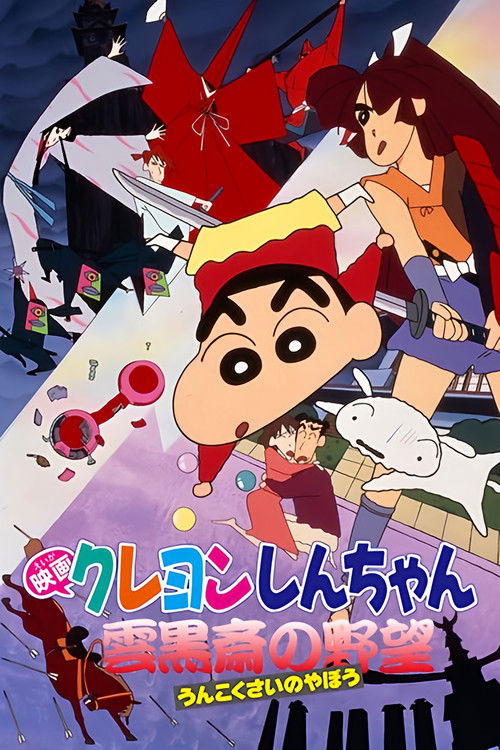
Crayon Shin-chan: Unkokusai's Ambition
Plot
A time traveler claims that bad guys are trying to change the past! Shin-chan is on the case, going back in time to defeat the evil Lord Unkokusai.
Get the Weekly Woke Watchlist
New and trending movies scored for woke bias, preachy messaging, and forced political themes — before you waste your evening.
No spam. One useful email per week.
Overall Series Review
Categorical Breakdown
The plot is a classic good vs. evil time-travel adventure where characters are judged entirely by their actions and combat effectiveness. The main characters, the Nohara family, are a standard Japanese family. Meritocracy is universal: the child Shin-chan's unique personality and absurd antics are what ultimately defeat the powerful villain, not any immutable characteristic.
The central conflict is the preservation of Japanese history—specifically the Sengoku period—and the modern Japanese home against a nihilistic, time-traveling 'Trend creator' from the future. The movie celebrates the worth of the past and the familial institution, portraying them as crucial elements worth saving, which is the direct opposite of civilizational self-hatred.
Gender dynamics are mostly played for comedy and parody within the existing family structure. The mother, Misae, is the catalyst for the adventure by demanding the return of her stolen property. A key ally, the samurai Fubukimaru, is a capable female warrior who has adopted a male guise to fight, which showcases female strength but also acknowledges traditional social structures. Men like Hiroshi and Shin-chan are often bumbling but essential heroes, reflecting a complementary rather than emasculating dynamic.
The movie includes comedic gender-bending, with the samurai Fubukimaru being revealed as a woman and the kidnapped 'sister' Yukino being revealed as a man, used as plot twists and gags typical of the series’ satirical style. These elements are not used to promote sexual ideology, center alternative sexualities as an identity, or lecture on gender theory. The traditional male-female pairing of the Nohara parents remains the stable, normative heroic center of the narrative.
The conflict is secular, involving magic, time travel, and a 'culturist' villain. No organized religion, specifically Christianity, is targeted or depicted as a source of evil or bigotry. The moral code is transcendent in a basic sense, acknowledging an objective good (saving history) and an objective evil (destroying time and reality).
Get the Weekly Woke Watchlist
New and trending movies scored for woke bias, preachy messaging, and forced political themes — before you waste your evening.
No spam. One useful email per week.