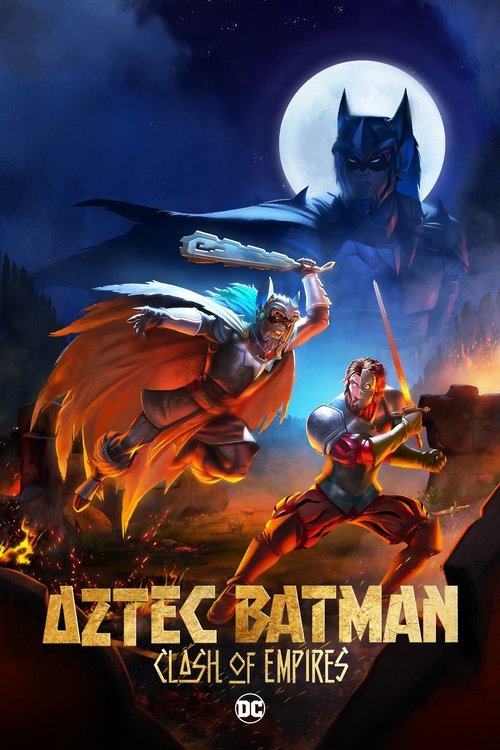
Aztec Batman: Clash of Empires
Plot
In the time of the Aztec empire, tragedy strikes Yohualli Coatl when his father is murdered by Spanish conquistadors. To warn King Moctezuma and his high priest, Yoka, of imminent danger, Yohualli escapes to Tenochtitlán. There, he trains in the temple of the bat god Tzinacan with his mentor, developing equipment and weaponry to confront the Spanish invasion and avenge his father’s death. Along the way, he encounters key figures like the fierce Jaguar Woman and the conquistador Hernán Cortés.
Get the Weekly Woke Watchlist
New and trending movies scored for woke bias, preachy messaging, and forced political themes — before you waste your evening.
No spam. One useful email per week.
Overall Series Review
Categorical Breakdown
The plot's central conflict hinges entirely on race, culture, and immutable characteristics, establishing an intersectional hierarchy. The white-European conquistador Hernán Cortés is the primary villain, representing 'systematic oppression' and genocide against the indigenous Aztec people. The hero, Yohualli Coatl, is defined by his indigenous identity and his quest to protect his people and avenge his father's murder by the Spanish. The narrative is framed as an effort to decenter the European colonizers.
The film frames the Spanish conquest as a fundamentally corrupt and evil invasion, portraying the Spanish Empire's actions as a 'genocidal war' and systematic oppression. The heroic narrative is built on defending the indigenous, non-Western home culture (Tenochtitlán) against the destructive Western-European external power, with the Spanish villain being driven by gold and a disregard for all rules.
The main hero's journey centers on Yohualli Coatl's intense training to become 'the best warrior ever' to protect his people, prioritizing traditional masculinity. Female characters are present as counterparts to DC figures, such as the 'fierce Jaguar Woman' and the 'enchanting Forest Ivy' who is an 'ayahuasca goddess' and guide. This suggests a presence of strong female archetypes, but the available information does not indicate an emasculation of the male lead or anti-natalist lecturing.
Plot summaries and cultural commentary provide no evidence of centering alternative sexualities, deconstructing the nuclear family, or promoting gender ideology. The focus is strictly on the historical, military, and spiritual clash of two empires.
The hero's training and power are rooted in the indigenous Aztec faith and mythology, specifically the 'bat god Tzinacan' who is the source of the hero's spiritual origin. The primary antagonist force—the Spanish conquistadors—is historically linked to the introduction of Christianity, which is implicitly rejected as the conquering ideology. The indigenous faith is framed as a source of heroic strength, directly opposing the invading culture.
Get the Weekly Woke Watchlist
New and trending movies scored for woke bias, preachy messaging, and forced political themes — before you waste your evening.
No spam. One useful email per week.