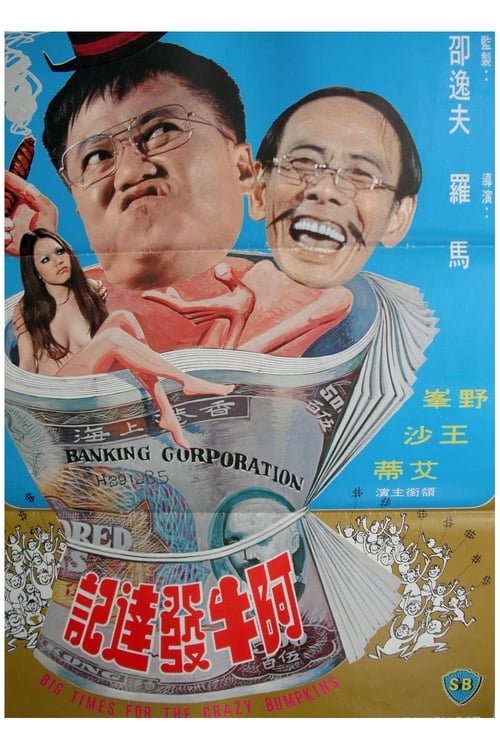
Big Times for the Crazy Bumpkins
Plot
In 1974, John Lo Mar co-directed The Crazy Bumpkins, a new variation on the time-tested, beloved Cantonese comedy "Country Bumpkin" tradition. That proved such a success that a sequel, Return Of The Crazy Bumpkins, soon appeared. Now, the third time's the charm, as John Lo Mar gets to both write and direct the third slapstick-filled installment, once again starring Yeh Feng and Wang Sha as the hapless and hilarious yokel Ah Niu and his crafty city-slicker Uncle Chou.
Get the Weekly Woke Watchlist
New and trending movies scored for woke bias, preachy messaging, and forced political themes — before you waste your evening.
No spam. One useful email per week.
Overall Series Review
Categorical Breakdown
Characters are judged entirely by their moral character; Ah Niu’s innocence and kindness are his defining positive traits, while Uncle Chou’s greed makes him the antagonist. The conflict is a class/moral divide between the 'country bumpkin' and the 'city slicker' without any reference to race, Western-style intersectional hierarchy, or the vilification of an ethnic majority. Casting is consistent with the Hong Kong Cantonese comedy tradition.
The movie criticizes the 'dominant culture' of 'consumerism and greed' found in the rapidly developing city of Hong Kong. This is a critique of moral corruption and modernity within the home culture, not a fundamental self-hatred of the civilization or its ancestors. It holds up traditional 'country values' like filial piety and humility as morally superior, which is a form of cultural reverence for a past ideal rather than civilizational self-hatred.
The core plot is a male-centric buddy comedy/moral fable, focusing on the dynamic between Ah Niu and his Uncle. Female roles mentioned, such as Ah Hua, are depicted as compassionate moral inspirations. The film appears to endorse traditional family values, with Ah Niu's journey starting with him attempting to earn money to send home to his ailing mother, supporting a vital, complementary view of the family structure.
The narrative makes no attempt to center or lecture on alternative sexualities or gender ideology. The film's brief mention of 'sexual temptations' frames them as part of the moral corruption Ah Niu must resist in the city, implicitly upholding a normative structure where sexuality is a private, non-central issue and part of a larger, traditional moral code.
The movie has a deeply moral, almost allegorical structure where 'greed' is the 'disease' and 'innocence' and 'kindness' are the antidote. The emphasis is on objective moral truth—that good character is superior to wealth—which actively works against a premise of moral relativism. The film is a classic moral fable that promotes a higher moral law, even without overt religious themes.
Get the Weekly Woke Watchlist
New and trending movies scored for woke bias, preachy messaging, and forced political themes — before you waste your evening.
No spam. One useful email per week.