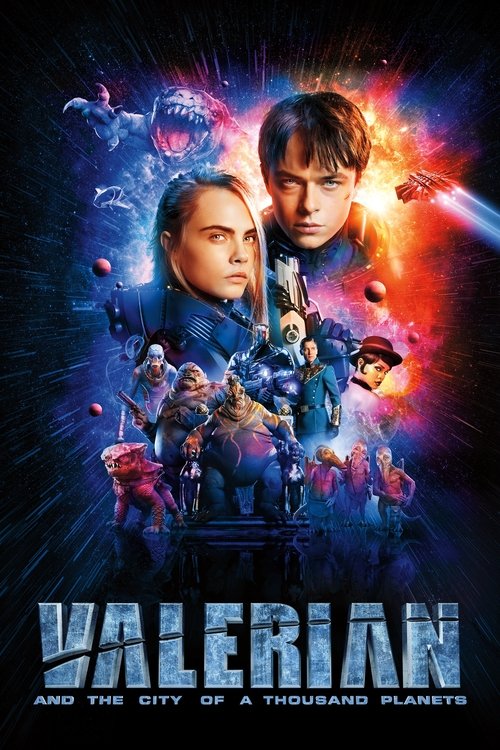
Valerian and the City of a Thousand Planets
Plot
In the 28th century, Valerian and Laureline are special operatives charged with keeping order throughout the human territories. On assignment from the Minister of Defense, the two undertake a mission to Alpha, an ever-expanding metropolis where species from across the universe have converged over centuries to share knowledge, intelligence, and cultures. At the center of Alpha is a mysterious dark force which threatens the peaceful existence of the City of a Thousand Planets, and Valerian and Laureline must race to identify the menace and safeguard not just Alpha, but the future of the universe.
Get the Weekly Woke Watchlist
New and trending movies scored for woke bias, preachy messaging, and forced political themes — before you waste your evening.
No spam. One useful email per week.
Overall Series Review
Categorical Breakdown
The plot heavily relies on a hierarchy of power and oppression. The central conflict is a 'war crime' where the human, white male-led military structure committed genocide against a peaceful, low-tech, distinctly non-white-analog alien species (the Pearls). The narrative casts the human military as the systemic oppressor for the benefit of the marginalized, victimized alien group, making the plot exist to expose privilege and systemic violence.
The film celebrates the universal diversity of the City of a Thousand Planets, but the specific institution of the established human military command is framed as fundamentally corrupt and responsible for the 'aggressive expansion' and destruction of the idyllic alien planet Mül. The indigenous Pearl species is depicted as a spiritually and culturally superior 'Noble Savage' archetype, living in harmony until they are wiped out by human aggression, which acts as a deconstruction of a segment of human heritage/civilization.
Laureline is depicted as the superior, 'no-nonsense' agent, possessing greater technical prowess and often correcting or rescuing the 'happy-go-lucky' and womanizing Major Valerian. This dynamic fits the 'Girl Boss' trope where the male lead is consistently made to look foolish or reckless to elevate the female lead's competence. However, the story's romantic subplot is conventional, concluding with the male lead's pursuit of marriage being validated.
The primary romantic plot is a traditional male-female courtship which ends with a successful marriage proposal. A brief, quickly dismissed joke occurs when Valerian learns an alien 'princess' soul was in his mind, with Laureline commenting on him having 'a girl inside' him. This fleeting moment is laughed off and does not serve as a centering of alternative sexualities or gender ideology within the main narrative.
Traditional religion is absent from the story, which focuses on exposing military corruption and political malfeasance. The morality is objective in that a genocidal war crime is universally bad, but this moral framework is secular, not transcendent. The narrative is not hostile toward faith, nor does it promote it as a source of strength; it simply operates in a spiritual vacuum regarding organized religion.
Get the Weekly Woke Watchlist
New and trending movies scored for woke bias, preachy messaging, and forced political themes — before you waste your evening.
No spam. One useful email per week.