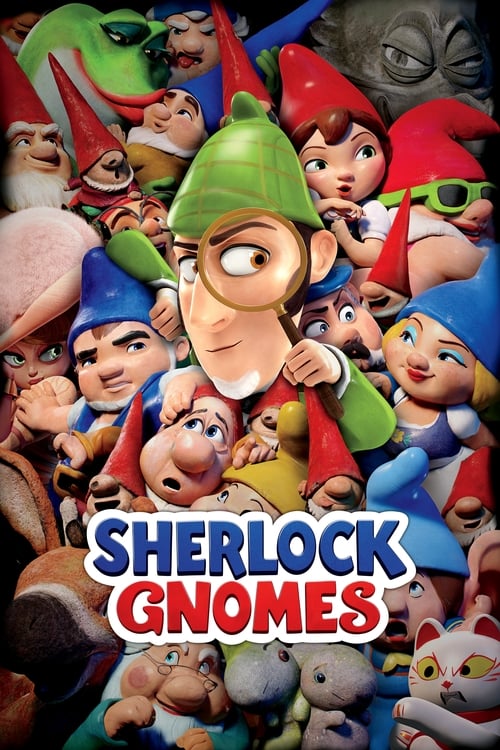
Sherlock Gnomes
Plot
Garden gnomes Gnomeo & Juliet recruit renown detective Sherlock Gnomes to investigate the mysterious disappearance of other garden ornaments.
Get the Weekly Woke Watchlist
New and trending movies scored for woke bias, preachy messaging, and forced political themes — before you waste your evening.
No spam. One useful email per week.
Overall Series Review
Categorical Breakdown
Voice casting features prominent minority actors in roles traditionally portrayed as white, such as Chiwetel Ejiofor as Dr. Watson and Mary J. Blige as Irene Adler, which is a form of colorblind casting for classic European characters. The gnome characters themselves maintain their traditional white/European appearance. One sequence set in a fantasy 'Chinatown' location is cited in some commentary as being 'racially reductive'. The plot's main theme centers on partners learning to respect each other's contributions (merit) rather than focusing on intersectional identity or privilege.
The plot's central motivation is the protection and rescue of the gnomes' new garden and all the ornaments that constitute their community. The setting is London, utilizing landmarks like the Natural History Museum and Tower Bridge, indicating a respect for the cultural setting. There is no narrative element suggesting that Western civilization, home, or ancestors are fundamentally flawed or corrupt, placing the focus on a simple criminal mystery.
Juliet is portrayed as a competent leader focused on her new 'day job' of managing the garden, which creates marital strain with Gnomeo. This positions her in a 'Girl Boss' type role where her career dedication is prioritized over the relationship. The film resolves this conflict not by vilifying the male or career, but by teaching both partners, Juliet and Gnomeo, as well as Sherlock and Watson, to value and cooperate as equals, promoting complementarianism based on shared strength. The final theme is that a 'right partner' makes one stronger.
The main relationships are the male-female married couple, Gnomeo and Juliet, and the professional partnership of Sherlock and Watson. The only non-normative element is the satirical trope of Sherlock and Watson being likened to an 'old married couple', which is common in many Holmes adaptations. There is no overt queer representation, gender ideology, or deconstruction of the nuclear family present in the plot or character arcs.
The film is a light children's adventure and does not address religion, faith, or moral philosophy. The conflict is a secular crime mystery involving missing ornaments and a villainous pie mascot. Morality is clearly defined as objective: kidnapping is wrong, and rescuing the victims is good.
Get the Weekly Woke Watchlist
New and trending movies scored for woke bias, preachy messaging, and forced political themes — before you waste your evening.
No spam. One useful email per week.