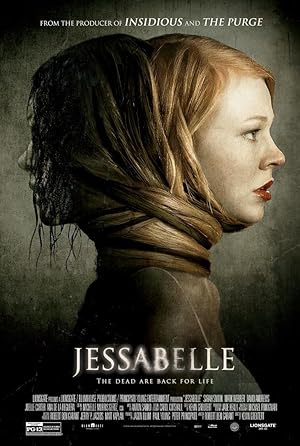
Jessabelle
Plot
Jessabelle "Jessie" Laurent is pregnant and accepts to move to the house of her boyfriend to raise a family of their own. However they have a car accident where her boyfriend and her baby die. Jessie is seriously wounded and trapped to a wheelchair, and the direction of the hospital asks her to contact her estranged father to help her. Leon Laurent brings his daughter to his house in Louisiana and lodges her in her mother's room. Jessie snoops around the room and finds a videotape where her mother Kate Laurent is pregnant and reads tarot cards to her. She tells that Jessie would never left Louisiana; she is attracted by water; and another woman wants her out of the house. However Leon arrives and destroys the tape. On the next morning, Jessie watches another videotape when her father is out of the house, and her mother talks about the man that had taught her to read cards, Moses. Jessie is haunted by the ghost of a woman and her father discovers the two other videotapes she has hidden. When he tries to destroy them, something happens to him and he is burnt to death trapped in a shed. During the funeral, Jessie meets her high-school friend Preston Sanders (Mark Webber), who is unhappily married. Preston decides to help Jessie after watching the videotapes. Who might be haunting Jessie?
Get the Weekly Woke Watchlist
New and trending movies scored for woke bias, preachy messaging, and forced political themes — before you waste your evening.
No spam. One useful email per week.
Overall Series Review
Categorical Breakdown
The entire mystery and plot twist center on a racist act: a white man's murder of a Black man and his own mixed-race infant daughter to preserve the illusion of his white family. The film explicitly uses the systemic oppression of historical racism as the foundational evil of the story. The white male father is revealed to be a racist, homicidal villain. However, Black characters, who are connected to Voodoo and Creole chants, are simultaneously depicted as a frightening and 'savage' supernatural 'Other,' a traditional, non-woke horror trope, which pulls the final score down from a perfect 10.
The film heavily deconstructs the white family's heritage and the Louisiana home. The family structure is rotten to its core, built on a grave lie, murder, and racism committed by the white father. The ancestral home is presented as corrupt, haunted, and a physical manifestation of the family's deep moral sickness. Institutions like the family are viewed as sources of chaos and deception rather than a shield, justifying a higher score. However, this corruption is personal and historic, not a broad lecture on all Western civilization.
The female protagonist, Jessie, is physically impaired, suffers a miscarriage, is emotionally traumatized, and is dependent on both her deceased mother's instructional videotapes and a male friend for assistance and investigation. She is a victim, not a 'Girl Boss' or a 'Mary Sue.' The male lead (Preston) is helpful and protective, though flawed. The narrative does not deliver an anti-natal message, as the loss of the baby is the initiating trauma. Gender roles are distinct and traditional, leading to a low score.
The movie contains no representation, themes, or subtext related to alternative sexualities, gender ideology, or the deconstruction of the nuclear family through a Queer Theory lens. The focus is entirely on a traditional family structure and its hidden, heterosexual, and biracial past. The structure is normative, giving the lowest possible score.
The central mystery, plot mechanics, and horror elements are driven by an occult worldview, specifically Voodoo and tarot card readings. These practices are presented as having real, transcendent power and are central to the mother's connection to the spiritual world and the film's climax. There is no counter-narrative of faith as a source of strength, nor is there any presence of transcendent Christian morality. The embrace of the occult in place of traditional religion as a central source of spiritual power pushes the score to a high level.
Get the Weekly Woke Watchlist
New and trending movies scored for woke bias, preachy messaging, and forced political themes — before you waste your evening.
No spam. One useful email per week.