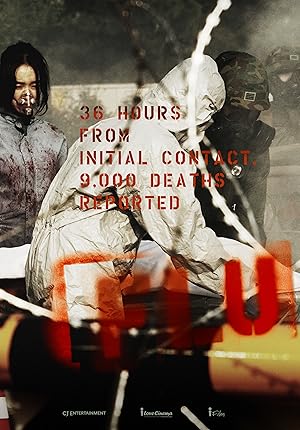
Flu
Plot
The worst epidemic ever seen is sweeping through Bundang, the suburb of Seoul. After smuggling illegal immigrants into the country, Byung-woo dies from an unknown virus. Soon after that, the same symptoms are plaguing scores of residents in Bundang. People are helpless against the airborne disease and the number of infected increases quickly, spreading chaos. As the worst-case scenario precaution, the city of half a million people, just 19 kilometers from Seoul, is about to be sealed off. The government orders a complete shutdown. Meanwhile, infectious disease specialist In-hye and rescue worker Ji-goo go into the closed city to find the blood serum of the index case, a crucial part of developing the vaccine.
Get the Weekly Woke Watchlist
New and trending movies scored for woke bias, preachy messaging, and forced political themes — before you waste your evening.
No spam. One useful email per week.
Overall Series Review
Categorical Breakdown
The outbreak begins with the death of illegal immigrants who were smuggled into the country, and the index case is an uncited young Filipino man named Monssai. The narrative treats this character, the most marginalized, as a disposable vessel for the cure, referring to him as the 'antibody carrier' and showing his death is largely without empathy or consequence for the main characters. The film's primary focus, however, is on the humanitarian crisis of the Korean citizens being oppressed by their own government, not a systemic lecture on racial/intersectional hierarchy.
The South Korean government, political elite, and administrators are framed as fundamentally craven, corrupt, and willing to sacrifice the common populace to save themselves and maintain the country's economic standing. The US Ambassador and the United States Forces Korea (USFK) are also portrayed negatively, reinforcing a decision to potentially massacre uninfected citizens to prevent a wider outbreak. The nation's leadership and its most significant Western ally are depicted as callous threats to the common people, which is a clear indictment of national and allied institutions.
The female lead is a highly competent, driven infectious disease specialist and single mother who takes decisive action to save her daughter and find a cure for the city. The male lead is also portrayed as a selfless, protective, and altruistic hero who puts himself in danger for the sake of the girl and the community. The gender dynamics are complementary, with both characters being strong in their respective professional and personal roles. The film ends with the man and woman marrying, establishing a normative, celebrated family unit.
The plot is entirely focused on the disaster, the government response, and the central, emerging heterosexual family unit of the doctor, the rescue worker, and the daughter. There is no presence of alternative sexual ideologies, centering of LGBTQ+ issues, or deconstruction of the nuclear family structure through a queer theory lens.
The narrative is primarily a political and humanitarian critique, with the moral compass defined by the choice between saving human lives and political self-preservation. There is no significant mention of organized religion, faith, or spiritual themes, and no direct hostility toward Christianity or traditional religion is present. The morality presented is a clear, transcendent call for basic human dignity and valuing life.
Get the Weekly Woke Watchlist
New and trending movies scored for woke bias, preachy messaging, and forced political themes — before you waste your evening.
No spam. One useful email per week.