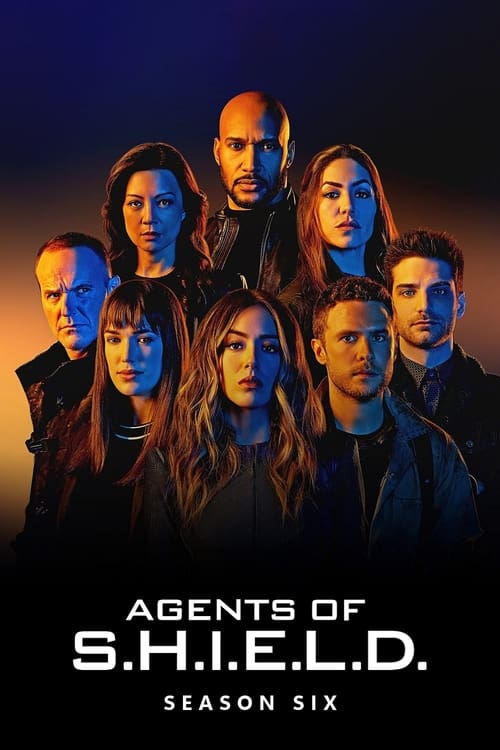
Marvel's Agents of S.H.I.E.L.D.
Season 6 Analysis
Season Overview
Last season, the team leaped forward in time to a dystopian future they soon realized must be prevented. While facing multiple timelines and new enemies from faraway planets, they found family, friends, teammates and the courage to pull off their biggest challenge yet. Their next challenge? Coming to grips with the knowledge that bending the laws of space and time may have saved the planet, but it couldn’t save Fitz or Coulson.
Season Review
Categorical Breakdown
The S.H.I.E.L.D. team is highly diverse, featuring a Black male Director (Mack), two primary Asian/Asian-American female field agents (May and Daisy), a Latina female field agent (Yo-Yo), and a new Black, gay scientist (Dr. Benson). The show maintains a clear meritocracy, as all these characters are established as the best in their respective fields based on years of character development, not immutable characteristics. The central antagonist, Sarge, is an alien entity inhabiting the body of a white male, which avoids the vilification of 'whiteness' as a class, instead making the issue one of spiritual corruption versus human merit.
The season is fundamentally about saving the Earth and humanity from two separate, external, and existential alien threats: the parasitic Shrike/Izel and the Chronicoms. The team, working for a global defense organization (S.H.I.E.L.D.), is entirely focused on protecting 'home' from destruction and invasion. Institutions like S.H.I.E.L.D. are viewed as essential shields against chaos, respecting the sacrifices made to keep them functioning.
Female characters like Daisy Johnson, Melinda May, and Jemma Simmons occupy roles as the primary powerhouse, the elite warrior, and the top scientist, respectively, and are all portrayed as highly competent without flaw. Male characters, including Director Mack and Fitz, are also shown as highly skilled and essential to the team's success; men are not systematically depicted as bumbling or incompetent. The strong, decades-long heterosexual marriage between Fitz and Simmons is a key, positive emotional anchor for the series. The emphasis is on complementary skills and merit within the team structure.
The show introduces Dr. Marcus Benson, a Black, gay scientist, as a new recurring character who is recruited for his intellectual merit. His sexual orientation is included as a fact of his character, which increases the score from the lowest end, but the narrative does not center the plot on his sexual identity. The core relationships and team dynamics remain focused on the normative male-female pairings of the long-established main cast. There is no lecturing on queer theory or deconstruction of the nuclear family as a plot point.
Religious themes are minimal. The main antagonists are extra-dimensional, non-corporeal entities and a robotic alien race, keeping the conflict in the realm of science fiction and cosmic horror, not a critique of traditional religion. The character Mack, who has a background of Christian faith, is the Director and a moral compass, and his faith is not presented as a source of bigotry or evil. The narrative acknowledges objective moral stakes (saving Earth from annihilation) rather than embracing pure subjective moral relativism.