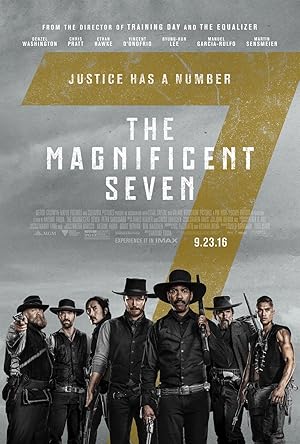
The Magnificent Seven
Plot
Director Antoine Fuqua brings his modern vision to a classic story in The Magnificent Seven. With the town of Rose Creek under the deadly control of industrialist Bartholomew Bogue, the desperate townspeople employ protection from seven outlaws, bounty hunters, gamblers and hired guns. As they prepare the town for the violent showdown that they know is coming, these seven mercenaries find themselves fighting for more than money.
Get the Weekly Woke Watchlist
New and trending movies scored for woke bias, preachy messaging, and forced political themes — before you waste your evening.
No spam. One useful email per week.
Overall Series Review
Categorical Breakdown
The composition of the eponymous group is overtly diverse, featuring a Black leader, a Mexican outlaw, an Asian knife expert, and a Native American warrior, which moves beyond a genuinely colorblind approach to a conscious effort at race-swapping for diversity. The main villain is a white industrialist, and the director admitted to being happy for him to be viewed as a modern political symbol of tyranny. However, the film avoids overt racial conflict or lecturing and instead depicts the diverse heroes uniting to save a predominantly white town.
The villain is a greedy, white industrialist who uses ruthless capitalist methods to seize land, framing the antagonist as a corrupt product of Western expansionism. However, the film's core message is not civilizational self-hatred but a universal tale of good fighting evil. The heroes fight to save the traditional Western frontier town and its populace, which is a theme of preservation, not deconstruction, of home and community.
Emma Cullen, the female character, is the instigator of the action, actively raising the funds and recruiting the heroes to fight. She is depicted as the 'only one with balls enough' among the townspeople and is established as a highly proficient shooter who personally delivers the final, fatal shot to the main villain. This clearly elevates the female lead to a 'Girl Boss' status and portrays the male townspeople as ineffective or cowardly.
There is a widely discussed but purely subtextual relationship between two of the seven men: the former Confederate sharpshooter and his Asian knife specialist partner. Their deep professional and personal bond suggests an alternative sexuality, which is an insertion of the theme, but it is not explicit, not a major narrative focus, and there is no accompanying ideological lecturing or deconstruction of family units.
The town's church is a central symbol, first burned by the villain to show his evil, and later serving as a sanctuary and defensive redoubt for the townspeople. One of the heroes, Jack Horne, is a devout, Scripture-quoting man whose faith is a positive character trait. The film uses the church as an anchor for justice and spiritual solace, explicitly positioning traditional Christian faith on the side of the heroes.
Get the Weekly Woke Watchlist
New and trending movies scored for woke bias, preachy messaging, and forced political themes — before you waste your evening.
No spam. One useful email per week.