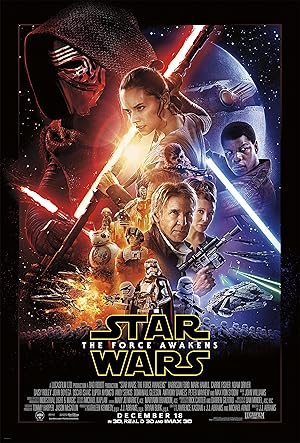
Star Wars: Episode VII - The Force Awakens
Plot
30 years after the defeat of Darth Vader and the Empire, Rey, a scavenger from the planet Jakku, finds a BB-8 droid that knows the whereabouts of the long lost Luke Skywalker. Rey, as well as a rogue stormtrooper and two smugglers, are thrown into the middle of a battle between the Resistance and the daunting legions of the First Order.
Get the Weekly Woke Watchlist
New and trending movies scored for woke bias, preachy messaging, and forced political themes — before you waste your evening.
No spam. One useful email per week.
Overall Series Review
Categorical Breakdown
The Resistance is portrayed as a diverse, multi-racial, and female-led coalition. The main villainous faction, the First Order, is depicted as an allegory for a white-male dominated oppressive force. The primary young hero is a white woman (Rey), and the primary young villain is a white man (Kylo Ren), who is shown as an unstable figure consumed by 'dominant masculinity'. The non-white male leads, Finn and Poe, are frequently depicted as less competent than Rey, with Finn functioning as a sidekick and Poe being captured early on.
The film frames the efforts and institutions created by the original heroes (Han, Leia, Luke) as a failure. The New Republic has been destroyed, and the new Jedi Order was decimated. The son of the original protagonists becomes the primary agent of destruction and a patricidal villain, actively deconstructing the heritage and legacy of the beloved family. The enemy, the First Order, is explicitly designed with visuals and themes that recall real-world civilizational oppressors like the Nazis, presenting the past order as something that simply regrew its evil.
The female protagonist, Rey, is presented as instantly proficient in complex skills such as piloting the Millennium Falcon, mechanics, using a blaster, and powerful Force abilities including mind tricks and lightsaber combat, all without prior training. This aligns strongly with the 'perfect instantly' or 'Mary Sue' trope. She explicitly rejects the protective impulses of the male lead, telling him she knows how to run without his help. The male characters, especially Finn and Kylo Ren, are portrayed as comparatively weaker, needing rescue, or being emotionally unstable and incompetent.
The core narrative does not feature or center alternative sexualities. The plot focuses on traditional male-female pairings and friendships, such as Rey and Finn, and the legacy of Han and Leia. There is no presentation of gender ideology or deconstruction of biological reality.
The movie is explicitly a fantasy battle between the light side and the dark side of the Force. The Force itself functions as a spiritual system with a clear, objective moral law defining good and evil actions. The plot seeks to restore the Force's light side, which directly counters moral relativism and anti-theistic themes.
Get the Weekly Woke Watchlist
New and trending movies scored for woke bias, preachy messaging, and forced political themes — before you waste your evening.
No spam. One useful email per week.