Eternity
Plot
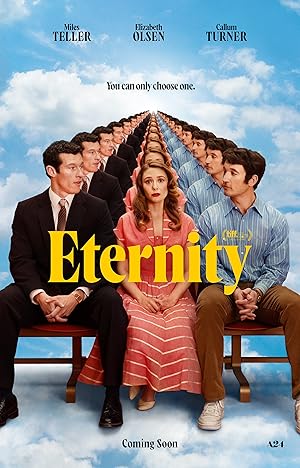
In an afterlife where souls have one week to decide where to spend eternity, Joan is faced with the impossible choice between the man she spent her life with and her first love, who died young and has waited decades for her to arr...
Get the Weekly Woke Watchlist
New and trending movies scored for woke bias, preachy messaging, and forced political themes — before you waste your evening.
No spam. One useful email per week.
Overall Series Review
Categorical Breakdown
The main cast is White, and the central conflict is a personal love triangle, not a political lecture. A prominent and powerful Afterlife Coordinator is a Black woman, an example of forced insertion of diversity into a position of authority. The Afterlife world includes an option specifically named 'Queer World,' and another named 'Man-free World,' which explicitly segments eternity based on identity groups and intersectional theory rather than universal experience.
The film criticizes the contemporary Western cultural focus on consumerism and endless choice by framing the afterlife as a 'glossy, mall-like purgatory' designed by late capitalism. However, the protagonist ultimately chooses the life she built over an idealized memory, which validates the concept of long-term commitment and the sacrifices of ancestors—represented by her 65-year marriage—over a fantastical alternative. This final decision provides a strong sense of gratitude for one's own lived history.
The core dilemma centers on the female protagonist's individual fulfillment, specifically noting her 'new determination not to sacrifice her own happiness for others, something she often did in her earthly role as a wife and mother.' The plot revolves around her making a choice for her own self-actualization, not for the men competing for her. This elevates the woman's personal desire over traditional, complementary roles. The Afterlife Coordinator is a female 'Girl Boss' figure in a position of bureaucratic power.
The world-building of the afterlife includes 'Queer World' as one of the many bespoke eternities available. This explicitly centers a sexual identity as a primary, foundational category for ultimate existence, normalizing and institutionalizing alternative sexuality within the film's quasi-divine structure. However, the main love story is a traditional male-female pairing, and there is no overt lecturing on gender theory.
The film completely substitutes any transcendent, traditional religious framework for the afterlife with a bureaucratic, consumer-driven 'Junction.' Instead of Heaven or Hell governed by a higher moral law, souls are offered a buffet of subjective, themed paradises like 'Smokers World,' 'Studio 54 World,' and 'Man-free World.' The highest moral law is replaced by a seven-day window to make a personal, relativistic choice from a list of commercial options.
Get the Weekly Woke Watchlist
New and trending movies scored for woke bias, preachy messaging, and forced political themes — before you waste your evening.
No spam. One useful email per week.