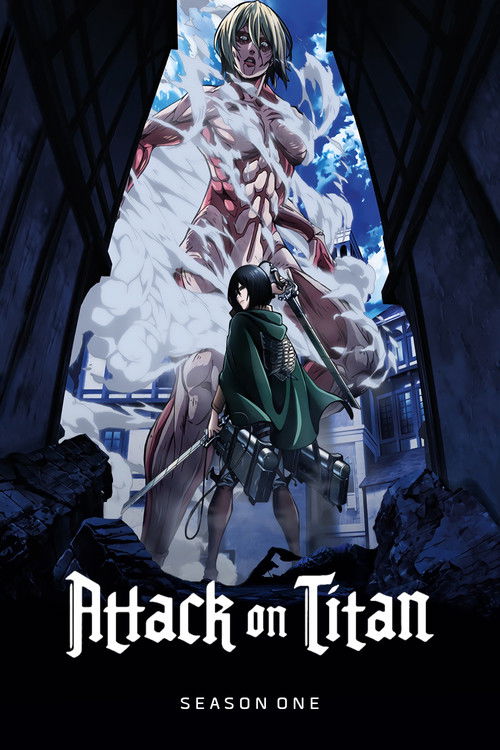
Attack on Titan
Season 1 Analysis
Season Overview
Centuries ago, mankind was slaughtered to near extinction by monstrous humanoid creatures called titans, forcing humans to hide in fear behind enormous concentric walls. What makes these giants truly terrifying is that their taste for human flesh is not born out of hunger but what appears to be out of pleasure. To ensure their survival, the remnants of humanity began living within defensive barriers, resulting in one hundred years without a single titan encounter. However, that fragile calm is soon shattered when a colossal titan manages to breach the supposedly impregnable outer wall, reigniting the fight for survival against the man-eating abominations.
Season Review
Categorical Breakdown
The narrative's primary focus is on meritocracy in the military, with all characters judged on their competence and will to fight the Titans. The protagonist, Eren Jaeger, is a German-coded male, who is often portrayed as less physically capable and more emotionally volatile than his peers, but his central struggle is driven by a deep desire for freedom, not a lecture on 'privilege.' One of the main characters, Mikasa Ackerman, has an Asian-coded heritage, but this is a personal backstory element and is not centered as a lens for systemic oppression within the walled society during this season.
The institutions of the walled civilization are depicted as fundamentally corrupt, self-serving, and decadent. The Military Police and the nobility, who live in safety in the innermost wall, are lazy and actively hoard resources while the poor starve. The government's decision to seal off the lost territory is framed as a heartless sacrifice of the poor. The entire existing system of safety, built on the gigantic walls, is later revealed to be a secret lie engineered by the royal family, reinforcing the idea that the 'home' is built on foundational corruption and deceit.
Female characters are instantly among the most competent and powerful soldiers in the series. Mikasa Ackerman is the strongest and most skilled member of the entire training corps, easily eclipsing her male comrades. The male protagonist, Eren, is repeatedly placed in the position of being rescued or protected by Mikasa, who is defined by her protective instinct toward him. This dynamic consistently places a female character in the superior 'sword' role and the male lead in a subordinate or 'shield' role, fitting the 'Girl Boss' trope where the female excels without struggle or flaw in combat.
In Season 1, the narrative does not center on alternative sexualities or gender ideology. All on-screen relationships or dynamics are heterosexual. The one major character whose gender is later revealed to be ambiguous (Hange Zoe) is not explicitly framed in this manner during the first season; their primary role is that of a brilliant, eccentric scientist obsessed with Titan research. The focus is entirely on survival and military strategy, keeping sexuality and gender identity private and non-ideological.
The most prominent religious institution is the 'Church of the Walls,' whose priests are depicted as fanatics and gatekeepers of ancient, secret knowledge. They actively interfere with the military's attempts to seal the wall and uncover the truth, seeking to conceal the massive Titan embedded within the wall. This frames organized, institutionalized faith as a force that is actively hostile to scientific curiosity, freedom, and the desperate effort to save humanity, serving only to maintain the status quo of a corrupt regime.