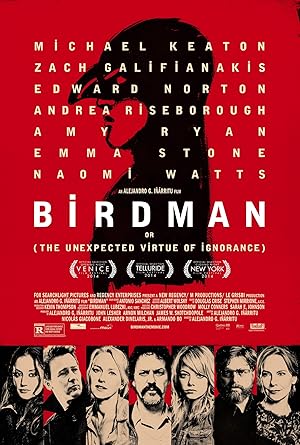
Birdman or (The Unexpected Virtue of Ignorance)
Plot
Actor Riggan Thomson is most famous for his movie role from over twenty years ago of the comic book superhero Birdman in the blockbuster movie of the same name and its two equally popular sequels. His association with the role took over his life, where Birdman is more renowned than "Riggan Thomson" the actor. Now past middle age, Riggan is trying to establish himself as a true artist by writing, directing, starring in and co-producing with his best friend Jake what is his Broadway debut, an adaptation of Raymond Carver's story, What We Talk About When We Talk About Love. He is staking his name, what little artistic reputation that comes with that name and his life savings on the project, and as such will do anything needed to make the play a success. As he and Jake go through the process of the previews toward opening night, Riggan runs into several issues: needing to find a replacement for the integral supporting male role the night before the first preview; hiring the talented Broadway name, Mike Shiner, for that role, Mike who ends up being difficult to work with and who may end up overshadowing Riggan in the play; having to deal potentially with a lawsuit based on one of his actions to ensure success; needing to be there for his daughter, Sam, who he has hired to be his production assistant and who has just come out of drug rehab; and pleasing the New York Times critic, Tabitha Dickinson, who wants to use any excuse to give the play a scathing review which in turn would close the show after the opening night performance. But Riggan's biggest problem may be his own insecurities, which are manifested by him constantly hearing what he believes to be the truth from the voice of his Birdman character, who he often battles both internally and externally.
Get the Weekly Woke Watchlist
New and trending movies scored for woke bias, preachy messaging, and forced political themes — before you waste your evening.
No spam. One useful email per week.
Overall Series Review
Categorical Breakdown
The film focuses entirely on the internal struggle, artistic ego, and career trajectory of the white male protagonist, Riggan Thomson. Character merit and individual talent, particularly as measured by commercial fame versus artistic critics, are the core dynamics. Race, immutable characteristics, and intersectional hierarchy are not factors in the plot or character development. The casting is colorblind to the extent that it serves the story's theatrical setting, and no character's race or 'whiteness' is vilified.
The central conflict is a critique of 'Big Hollywood' (superhero franchises) by 'High Art' (Broadway theater), both of which are institutions firmly within Western culture. The film is a satire of contemporary American media culture, but it does not frame home culture as fundamentally corrupt or racist, nor does it demonize ancestors or employ a 'Noble Savage' trope. It is an internal critique of artistic value, not a call for civilizational self-hatred.
The score is low to moderate because the male protagonist, Riggan, is deeply flawed, narcissistic, and an unfaithful husband and neglectful father, which is a form of emasculation through incompetence. However, the female characters are also flawed: the daughter Sam is cynical and recently out of rehab, and the actresses are struggling with career desperation. They are complex individuals, not 'perfect instantly' Mary Sues. The plot is overwhelmingly centered on male ego, making the women's roles secondary and in relation to him, which works against the 'Girl Boss' trope, but the male character is clearly a toxic figure.
The narrative makes no attempt to center alternative sexualities or deconstruct the nuclear family as a system of oppression. The family unit is broken due to the specific character flaws of Riggan (infidelity and self-absorption), treating the breakdown as a personal, private drama. Sexuality is not a focus of the film's themes, and there is no discussion or lecturing on gender ideology.
The narrative is rooted in existential philosophy, focusing on the individual's desperate and ultimately ambiguous search for meaning and self-worth in a chaotic world. The opening of the film explicitly uses an existential text, pointing to a secular, subjective pursuit of 'selfhood.' This creates a 'Spiritual Vacuum' by focusing on man-centered morality and subjective 'truth.' However, there is no overt hostility toward traditional religion, and no Christian character is depicted as a villain or bigot; the absence of faith is simply the assumed background state of the modern artistic world.
Get the Weekly Woke Watchlist
New and trending movies scored for woke bias, preachy messaging, and forced political themes — before you waste your evening.
No spam. One useful email per week.