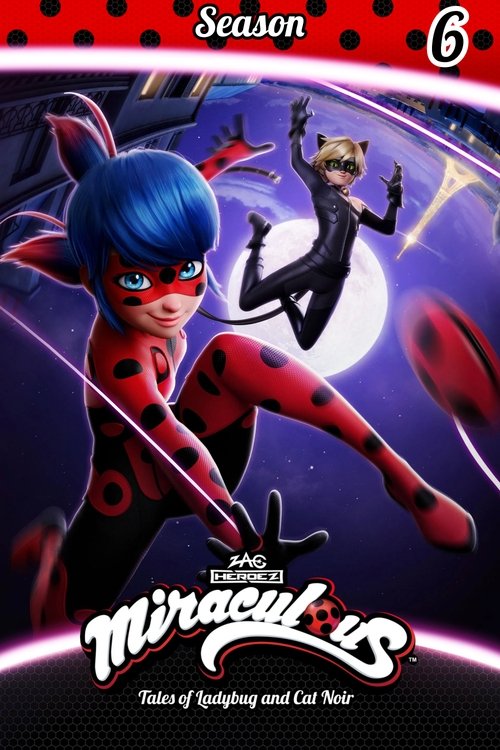
Miraculous: Tales of Ladybug & Cat Noir
Season 6 Analysis
Season Overview
Ladybug and Cat Noir must face a new enemy – mysterious, worrying, elusive, and yet close to them. Very close, but they have no idea. Marinette and Adrien too have never been so close to each other, but that does not necessarily make their everyday life a bed of roses, for they keep secrets from each other. The biggest secret being that they still do not know that they are Ladybug and Cat Noir. In a new and exemplary green Paris, in the heart of a new and revolutionary school, our heroes are about to experience a school year full of emotions and revelations.
Season Review
Categorical Breakdown
The narrative places the female protagonist, Ladybug, in a position of authority above her male partner, Cat Noir, whose role is continually diminished despite his co-star status. The main male protagonist, who is white, is actively ‘nerfed’ and ‘treated like a nobody,’ while the secondary characters of diverse ethnic backgrounds are elevated as the primary support team and secondary guardians. The main villain, Lila Rossi, is an Italian-coded female master manipulator, not a vilified 'white male' archetype. Character struggles, such as Ivan being the son of a villain and choosing to be a 'gentle giant,' are judged by merit and soul content, but the clear hierarchy established by gender and the sidelining of the white male hero pushes the score high.
The season sets its scene in a 'new and exemplary green Paris' and a 'new and revolutionary school,' suggesting the rejection or deconstruction of traditional French and Western institutions and urban planning in favor of an untested, progressive model. The main conflict does not involve direct demonization of national or ancestral heritage, but rather a focus on personal secrets and villainy. The new setting implies a preference for a constructed, 'exemplary' future over existing, historical structures.
Ladybug holds near-absolute power as the Guardian, making all unilateral decisions, including keeping Cat Noir in the dark about crucial secrets and giving the new secondary Guardian position to her female friend, Alya, instead of her male partner. Cat Noir is consistently depicted as less competent and is marginalized to the point where he is seen by fans as being 'nerfed' and 'treated like a nobody,' serving primarily as a supportive love interest. This strongly embodies the 'Girl Boss' trope and emasculation of the male hero. The narrative prioritizes the female lead's emotional development and authority above the balance of the partnership.
A key side character, Nathaniel, is confirmed to have a boyfriend, Marc, and an episode focuses on their relationship and his parents' disapproval of his hobbies, which are connected to his identity. This explicitly centers a same-sex relationship and frames parental resistance as the source of conflict, using the narrative to normalize and advocate for alternative sexual identities in a children's program. Sexual identity is made a primary narrative point for this character and their character growth.
There is no direct plotline or explicit commentary criticizing traditional religion, anti-theism, or the depiction of Christian characters. The moral axis remains firmly rooted in objective good versus evil tied to the magical Miraculouses and the ethical dilemma of truth versus lies, as Marinette struggles with her conscience. Morality is not framed as subjective 'power dynamics,' but as a clear right and wrong path that the heroes must navigate, leading to a neutral score in the absence of relevant content.