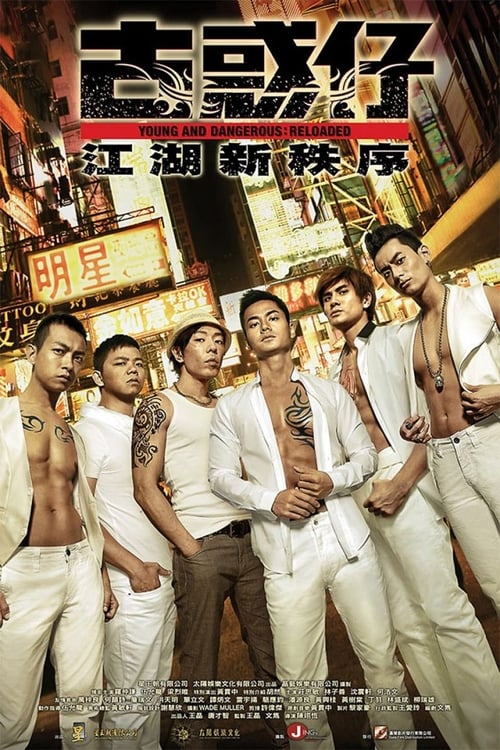
Young and Dangerous: Reloaded
Plot
On a dark Mongkok night, May, the cousin of Dai Tin-yee, was gang-raped to death by Med King and his men. The furious Tin-yee, together with his buddies, Ho-Nam, Chicken, Pou-Pan tracked down Med King to revenge May’s death. As Med King was under the wing of Ugly Kwan, a leader of the Hung Hing triad, Kwan gave orders to get rid of Ho-Nam by all means….
Get the Weekly Woke Watchlist
New and trending movies scored for woke bias, preachy messaging, and forced political themes — before you waste your evening.
No spam. One useful email per week.
Overall Series Review
Categorical Breakdown
The film is a Hong Kong production with an ethnically homogenous East Asian cast centered on a purely local, internal conflict within a Chinese triad. There is no narrative focus on immutable characteristics, intersectional hierarchy, or the vilification of 'whiteness.' Characters are defined by their standing, loyalty, and courage within the triad structure.
The film is set in the criminal underworld of Hong Kong, depicting a violent and corrupt subculture, which is an inherently negative portrayal of a social institution. However, the narrative centers on the protagonists striving to embody a higher code of 'honor' and 'righteousness' within this chaotic institution (the Hung Hing gang), viewing their loyalty as a shield against the true evil represented by the villain. There is no deconstruction of Chinese or Hong Kong heritage itself, nor is there a 'Noble Savage' trope.
The inciting event is the brutal gang-rape and murder of a woman, which serves as the primary motivation for the male protagonists' violent quest for justice. Women are depicted as victims or sexualized love interests, and the overall dynamic is hyper-masculine, focused on male 'brotherhood' and action. The film contains scenes of nudity and a soft-core element which objectifies women, directly contrasting with the 'Girl Boss' and 'emasculation of males' tropes.
The narrative is completely dominated by traditional male-female dynamics and a hyper-masculine 'brotherhood' structure. No presence of alternative sexual ideologies, deconstruction of the nuclear family, or gender theory lecturing is observed.
The moral compass of the film is a secular one, revolving around the traditional Triad values of 'loyalty,' 'honor,' and 'brotherhood' as a code to live and die by. While the setting is morally relativistic (it's a crime film), there is no direct hostility toward traditional religion or Christianity, nor are religious figures villainized. The film acknowledges a transcendent moral law in the form of a gangster's code of honor, even though the context is criminal.
Get the Weekly Woke Watchlist
New and trending movies scored for woke bias, preachy messaging, and forced political themes — before you waste your evening.
No spam. One useful email per week.