The 100
Season 4 Analysis
Season Overview
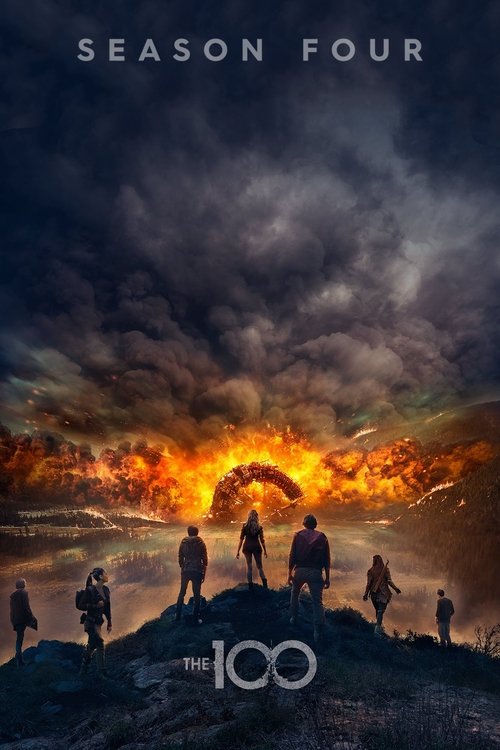
The fight to survive has torn The 100 apart, turned them against each other, and taken the lives of their closest friends. Last season, our heroes found themselves at the epicenter of both the Grounder world and the struggle for Arkadia’s soul. Despite their best efforts, war appeared unavoidable, until a new, even more dangerous threat – one that had been quietly rising all along – exploded to the surface: ALIE, the A.I. that ended the world, offered relief from pain and eternal life in the “City of Light.” But as her ranks grew, it quickly became clear that she was building an army dedicated to controlling all sentient life on Earth. This was no longer a battle between warring factions; it was a fight for humanity itself. Now, a hard truth lands on the shoulders of those who remain. Will they go quietly into the night, or will they find hope and faith in each other, as they face their darkest chapter yet?
Season Review
Categorical Breakdown
The narrative frames the conflict around 'Sky People' (Skaikru), a proxy for modern/Western civilization, and their hypocrisy in attempting to save only their own lives. The arc culminates in a non-Skaikru identifying hero (Octavia) winning a battle to secure the last bunker, only to reject her clan's self-interest in favor of an 'equitable' split among all clans regardless of their skills or contribution. The protagonist, a white female, is even critiqued in external commentary for a 'white feminism' that overlooks her poor treatment of non-white characters, suggesting the narrative prioritizes her position in an intersectional hierarchy. The core story validates the rejection of meritocracy for a vision of universal, enforced equity.
The Arkadian society (Skaikru) represents the remnants of the 'old world' whose nuclear failures caused the new apocalypse, thereby directly demonizing their ancestors. The leaders of this society are consistently depicted as morally compromised, willing to kill their own people or experiment on others to survive. The opposing Grounder culture, though savage, is presented as having a superior code of honor and is ultimately adopted as the moral compass by the hero who saves all survivors (Octavia).
Female characters overwhelmingly dominate the major strategic, scientific, and political leadership roles (Clarke, Octavia, Raven, Abby, Indra). The show is explicitly praised in commentary for shattering the idea of patriarchy and gender essentialism. Male characters are frequently portrayed as either emotionally vulnerable, consumed by guilt, or the source of major failures. The protagonist's primary function is a 'Girl Boss' who makes all the 'hard choices' for the collective.
The protagonist, Clarke Griffin, is canonically bisexual. The season features other gay and bisexual characters in non-token, meaningful roles (Niylah, Miller, Jackson). The sexualities of the characters are often noted in commentary for being casually presented and not central to the main plot, which reduces the didactic score. The focus on alternative sexualities is an established fixture of the series, indicating an embedded queer theory lens without the heavy-handed lecturing on gender theory.
The core of the show is built on a theme of 'Moral Ambiguity,' emphasizing that 'there are no good guys' and that all moral choices are subjective and relative to saving one's own people. Religion is consistently framed as either a dangerous cult (like the 'City of Light' plot from the prior season, which is referenced in the setup for the new 'Second Dawn' cult) or a primitive cultural ritual based on an artificial construct (the Grounder Commander tradition is rooted in an AI). Faith itself is presented as a search for an 'easy answer' or a means to cope with pain, not a source of transcendent morality.