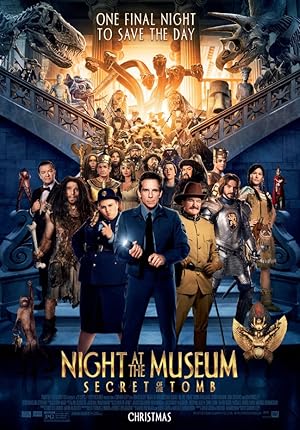
Night at the Museum: Secret of the Tomb
Plot
At the Museum of Natural History, there's a new exhibit being unveiled. Larry Daley, who manages the night exhibit where the exhibits come to life because of the Tablet of Ahkmenrah, is in charge of the presentation. But when the exhibits go awry, Larry finds himself in trouble. He learns the Tablet is corroding so he does some research and learns that Cecil, the former museum guard, was at the site when the Tablet was discovered. He tells Larry they were warned if they remove it could mean the end. Larry realizes it means the end of the magic. He talks to Ahkmenrah who says that he doesn't know anything. Only his father the Pharaoh knows the Tablet's secrets. He learns that the Pharaoh was sent to the London museum. So he convinces Dr. McPhee, the museum curator, to help send him to London. He takes Ahkmenrah with him but some of the others tag along, like Teddy Roosevelt, Attila, Octavius, and Jedediah.
Get the Weekly Woke Watchlist
New and trending movies scored for woke bias, preachy messaging, and forced political themes — before you waste your evening.
No spam. One useful email per week.
Overall Series Review
Categorical Breakdown
The characters, who represent various historical eras and cultures, are judged entirely on their merit, personality, and role in the adventure. Larry Daley, a white male, is the competent, caring protagonist and leader whose arc is about accepting his responsibility. The antagonist is a white male, Sir Lancelot, whose actions stem from a delusional sense of honor, not from a critique of 'whiteness.' There is no evidence of historical race-swapping or forced diversity, and the casting of historical figures is generally authentic to their museum exhibits.
The central conflict is a quest to save the 'magic' of history, championing the vitality and inspirational power of museums and the exhibits of both American and British/Western civilization. The journey to the British Museum is presented as an exciting, grand adventure that respects the new setting. The concept of an Egyptian curse is the mildest possible critique of colonial-era archaeology, framed as a consequence of removing the tablet, but the film ultimately celebrates institutions and ancestors by fighting to keep them alive.
The main emotional arc is centered on the male protagonist, Larry Daley, and his relationship with his son, Nick. Men and women are presented in complementary roles; for instance, Teddy Roosevelt and Sacagawea are a couple. The new female night guard, Tilly, is a source of comedic relief and a quirky supporting character, not an instantly perfect 'Girl Boss' who eclipses the male lead. The story does not feature anti-natalist or anti-family messaging, instead placing a strong emphasis on the father-son bond.
The narrative adheres to a normative structure. The emotional focus is the heterosexual father-son relationship. Any pairings, such as Jedediah and Octavius or Teddy Roosevelt and Sacagawea, are presented as traditional male friendship or male-female coupling. There is no presence of alternative sexual ideology or lecturing on gender theory for the family audience.
The core of the plot is an Egyptian artifact and its 'magic,' which is treated purely as a fantasy device for comedy and adventure, not a commentary on any modern or historical religion. The film contains no characters who villainize or lecture against traditional religion, specifically Christianity. Morality is objective, driven by the need to save the lives of all the exhibits, reflecting a transcendent moral law of saving one's friends.
Get the Weekly Woke Watchlist
New and trending movies scored for woke bias, preachy messaging, and forced political themes — before you waste your evening.
No spam. One useful email per week.