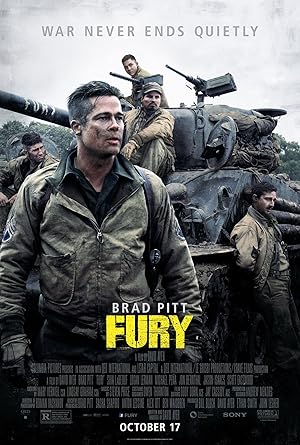
Fury
Plot
April, 1945. As the Allies make their final push in the European Theatre, a battle-hardened Army sergeant named Wardaddy commands a Sherman tank and his five-man crew on a deadly mission behind enemy lines. Outnumbered, out-gunned, and with a rookie soldier thrust into their platoon, Wardaddy and his men face overwhelming odds in their heroic attempts to strike at the heart of Nazi Germany.
Get the Weekly Woke Watchlist
New and trending movies scored for woke bias, preachy messaging, and forced political themes — before you waste your evening.
No spam. One useful email per week.
Overall Series Review
Categorical Breakdown
The crew's effectiveness and standing are based purely on combat experience and their ability to function as a unit, strongly emphasizing universal meritocracy. The veteran crew includes men of varying ethnic backgrounds, but the narrative does not focus on their race or immutable characteristics as a source of conflict or a lecture on privilege. No characters are race-swapped, and white characters are not generally depicted as incompetent or evil, only as brutalized by war.
The American soldiers are depicted as morally ambiguous and brutal, engaging in war crimes like summarily executing prisoners and threatening German civilians, which deconstructs the 'Greatest Generation' narrative. However, the film maintains a clear moral opposition against the Nazi SS troops and culminates in a final, heroic sacrifice to defend the main thrust of the Allied invasion, showing a defense of the civilizational mission against an external evil.
The core cast is exclusively male and hyper-masculine. Female characters are extremely rare and appear only as German civilians who are either victims of artillery or are objectified and made subservient to the American soldiers, completely avoiding the 'Girl Boss' or 'Mary Sue' tropes. Masculinity is highly protective within the unit, and there is no messaging that suggests men are bumbling or that motherhood is a prison.
The movie contains zero overt references to alternative sexualities, gender ideology, or the deconstruction of the nuclear family. The sexual dynamics in the film focus on the heterosexual encounters between soldiers and local women. The intense bond between the all-male tank crew is framed explicitly by the director as a 'closer than brothers' dynamic forged by combat, affirming a normative structure.
One of the five main characters, the gunner 'Bible,' is a devout and respected Christian who frequently reads Scripture, quotes the Bible, and prays. The other, non-religious crew members respect his faith. This character's belief is portrayed as a genuine source of emotional strength and moral framework in the face of brutal violence, directly counteracting the trope that traditional religion is a root of evil or that Christian characters are villains.
Get the Weekly Woke Watchlist
New and trending movies scored for woke bias, preachy messaging, and forced political themes — before you waste your evening.
No spam. One useful email per week.