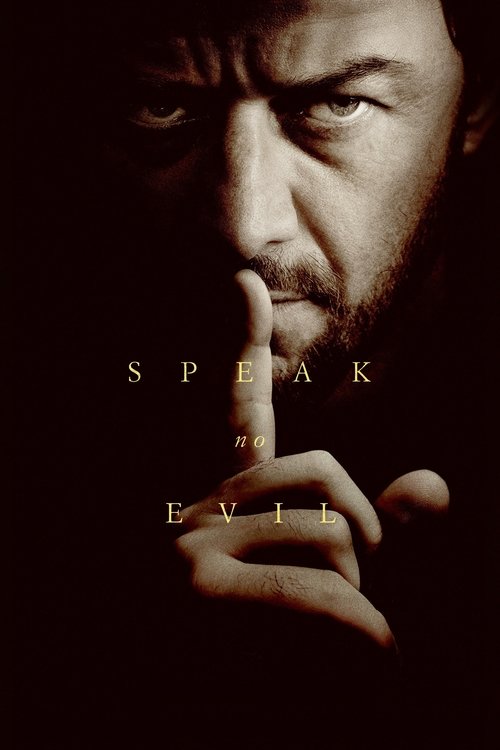
Speak No Evil
Plot
When an American family is invited to spend the weekend at the idyllic country estate of a charming British family they befriended on vacation, what begins as a dream holiday soon warps into a snarled psychological nightmare.
Get the Weekly Woke Watchlist
New and trending movies scored for woke bias, preachy messaging, and forced political themes — before you waste your evening.
No spam. One useful email per week.
Overall Series Review
Categorical Breakdown
The plot is not driven by racial or intersectional politics; the conflict is between two white, middle-class families of similar socio-economic backgrounds, one American and one British/Eastern European. The villain is a white male, but his evil is characterized by psychopathy and manipulative sadism rather than an indictment of 'whiteness' or systemic power structures. The characters' failings are rooted in universal human traits like meekness and conflict aversion, not immutable characteristics.
The central thesis is a severe critique of a core Western cultural norm: extreme politeness and civility. The narrative suggests that this value is a profound societal weakness, a form of 'luxury belief,' and that adhering to it in the face of malice is self-destructive. The Daltons' failure to defend themselves is directly attributed to their bourgeois fear of confrontation and breaking social rules, framing a central element of Western culture as fundamentally corruptible and fatal. This deconstruction of a social institution scores moderately high.
The male protagonist, Ben, is consistently portrayed as bumbling, miserable, and emasculated, repeatedly failing to stand up for his wife or family. The wife, Louise, grows into the capable and 'perfect strong mother' who is the only family member willing to fight and take risks to protect the children. This clear dynamic establishes a 'Girl Boss' trope where the female lead is presented as superior and the male lead is depicted as incompetent and cowardly in a crisis, which is a strong theme of male emasculation.
The film focuses exclusively on two traditional heterosexual, nuclear families. There are no LGBTQ+ characters or plot points, and the narrative contains no ideological lecturing about alternative sexualities, queer theory, or gender ideology. The core conflict is rooted entirely within conventional male-female and parent-child pairings.
The film's atmosphere is defined by profound nihilism, concluding that the world is 'violent and unrelenting' and that the strong will always prey on the weak. The moral order of the universe is portrayed as a subjective power dynamic where civility is weaponized and the capacity for evil goes fundamentally unpunished or unexplained. This pervasive spiritual vacuum and rejection of Objective Truth in favor of absolute moral relativism scores high, though there is no explicit vilification of Christianity or organized religion.
Get the Weekly Woke Watchlist
New and trending movies scored for woke bias, preachy messaging, and forced political themes — before you waste your evening.
No spam. One useful email per week.