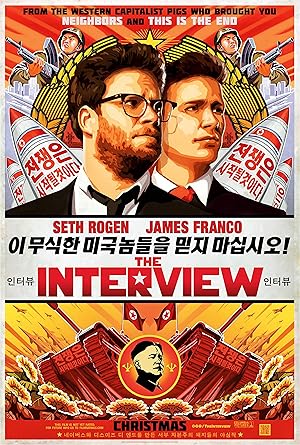
The Interview
Plot
In the action-comedy The Interview, Dave Skylark (James Franco) and his producer Aaron Rapoport (Seth Rogen) run the popular celebrity tabloid TV show "Skylark Tonight." When they discover that North Korean dictator Kim Jong-un is a fan of the show, they land an interview with him in an attempt to legitimize themselves as journalists. As Dave and Aaron prepare to travel to Pyongyang, their plans change when the CIA recruits them, perhaps the two least-qualified men imaginable, to assassinate Kim Jong-un.
Get the Weekly Woke Watchlist
New and trending movies scored for woke bias, preachy messaging, and forced political themes — before you waste your evening.
No spam. One useful email per week.
Overall Series Review
Categorical Breakdown
The movie is criticized for relying on "cliché Asian stereotypes," "fabricated accents," and "orientalism." The premise is framed by some as a "White Man's Burden" fantasy where two white male protagonists must save a non-white population from their non-white leader, utilizing race and immutable characteristics for comedic effect rather than character merit. The humor includes one-dimensional and sexualized tropes of Asian women. The vilification of the North Korean culture and its people through lazy stereotyping drives a high score.
The film's primary target for satire and condemnation is a totalitarian communist regime (North Korea), which is ideologically antithetical to Western values. The criticism of systems opposed to liberty, democracy, and freedom does not constitute self-hatred. A minor moral pivot by a North Korean character critiques the specific American foreign policy of killing leaders, but this is a nuance and not an attack on core Western institutions, resulting in a very low score.
Gender dynamics are defined by the emasculation of the male leads, who are portrayed as two bumbling, incompetent buffoons, one a 'sleazy asshole' and the other an 'underperforming schlub.' The two main female characters, CIA Agent Lacey and North Korean official Sook, are the highly competent, authoritative, and morally superior figures who set the mission's strategy and moral compass, fitting the 'Girl Boss' trope that elevates women at the expense of male competence.
The film features 'heh heh it's funny because it's gay jokes' and is noted as containing homophobic elements, but these are used as sources of crude, non-ideological comedy. The narrative does not center alternative sexualities, deconstruct the nuclear family as an oppressive structure, or engage in political lecturing on gender theory. The jokes are a part of the film's overall raunchy style and not an explicit promotion of a 'Queer Theory Lens.'
The film satirizes the totalitarian, cult-of-personality regime in North Korea, where the leader is deified in a quasi-religious sense (Juche philosophy). The narrative's goal is to expose this deification as a lie, championing objective reality and freedom against a state-enforced spiritual vacuum. This is a critique of a secular/communist 'state religion,' not an attack on traditional, transcendent Western faith, resulting in a low score.
Get the Weekly Woke Watchlist
New and trending movies scored for woke bias, preachy messaging, and forced political themes — before you waste your evening.
No spam. One useful email per week.