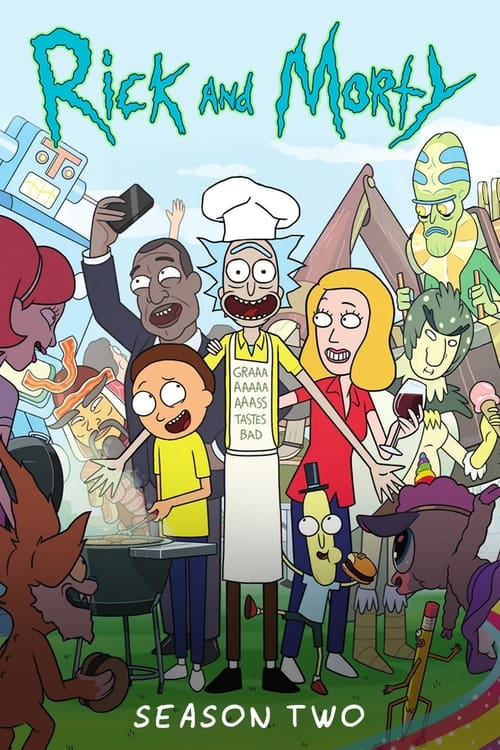
Rick and Morty
Season 2 Analysis
Season Overview
After Rick and Morty decided to unfreeze time, they must deal with alien parasites, alternate Jerrys and a decaying, possibly non-existent dimension.
Season Review
Categorical Breakdown
The episode 'Auto Erotic Assimilation' features Unity, a hive mind capable of assimilating all races into a single entity. The narrative shows that when Unity releases control, the assimilated individuals immediately begin a chaotic and violent race war based on their former distinctions, suggesting that raw identity politics lead to conflict rather than meritocracy. The show's core human cast is entirely white, with Rick serving as a universally toxic, narcissistic figure, not a villain based on his race.
The season promotes extreme civilizational self-hatred through the lens of nihilism. Rick consistently expresses contempt for Earth, the American government, and the suburban home. The episode 'The Ricks Must Be Crazy' illustrates a microverse civilization trapped solely to power a vehicle, portraying Rick’s advanced civilization as inherently exploitative. The climax sees the Smith family forced to flee Earth after Rick's friend is revealed to be a resistance fighter, signifying the ultimate destruction of the 'home' concept.
The core family dynamic presents a clear deconstruction of traditional gender roles: Jerry is a bumbling, pathetic, and insecure male, while Beth is a highly intelligent, dominant, and emotionally troubled woman who rejects domesticity. Summer is consistently portrayed as increasingly competent, resourceful, and adventurous, often outshining Morty, pushing her character toward the 'Girl Boss' archetype. The toxicity of the nuclear family is a constant source of drama.
The episode 'Auto Erotic Assimilation' features Rick's ex-lover, Unity, a pan-sexual, multiracial hive mind that can take on countless forms. This alien entity explicitly subverts and deconstructs traditional male-female pairing and normative sexuality, making an alternative sexual existence a central plot device for a major episode. The portrayal is not a simple representation but a high-concept exploration of non-normative relationships.
The show is anchored by Rick's philosophy of radical, existential nihilism which dictates that all existence is meaningless, directly negating the concept of Transcendent Morality. The episode 'Get Schwifty' directly satirizes organized religion by showing a cult-like religion forming around a giant alien head demanding a hit song. The narrative makes clear that the 'Headism' religion is a fallacious belief system based on pure misinterpretation and flawed correlation.