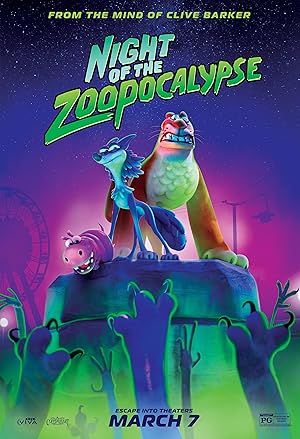
Night of the Zoopocalypse
Plot
A wolf and mountain lion team up when a meteor unleashes a virus turning zoo animals into zombies. They join forces with other survivors to rescue the zoo and stop the deranged mutant leader from spreading the virus.
Get the Weekly Woke Watchlist
New and trending movies scored for woke bias, preachy messaging, and forced political themes — before you waste your evening.
No spam. One useful email per week.
Overall Series Review
Categorical Breakdown
The narrative explicitly champions universal meritocracy and teamwork, as the animals 'overcome their natural animosities and differences' to survive. While the main leader is a female (Gracie the wolf), and the ensemble cast is highly 'diverse' in species and includes one character (Frida the capybara) with a mild cultural marker (Spanish accent) based on her origin, the plot does not rely on race, immutable characteristics, or intersectional hierarchy. The antagonist (Bunny Zero) is a deranged mutant, not a stand-in for a privileged class.
The film actively rejects the theme of civilizational self-hatred. The plot is about the protagonists actively *saving* their home (the zoo) and, by extension, the outside world, from the alien virus. The male co-lead, Dan, initially desires to escape the zoo (his 'home') and prioritizes self-interest, but his character arc is a clear rejection of this isolationism as he learns to choose community and sacrifice over his desire for the wild. This aligns with the 'Gratitude & Chesterton’s Fence' side of the spectrum.
Gracie, the young timber wolf, is the 'de facto leader,' clever, and resourceful, placing her in the 'Girl Boss' adjacent category. Dan, the mountain lion, is gruff and isolationist, embodying a character who needs to grow to become a protective force. While the female lead is instantly more competent at leadership than the male co-lead (whose flaw is moral/social, not competence-based), he is not depicted as a 'bumbling idiot.' Their relationship ends in complementary teamwork, and the themes of anti-family/anti-natalism are entirely absent, as the plot focuses on survival and community.
Content is minimal. One supporting character, Ash the ostrich, is described in a cast list as 'sarcastic, fabulous,' which is a minor potential cultural cue, but the plot does not center sexual ideology, deconstruct the nuclear family (which is not a feature of an animal zombie film), or promote gender ideology. The structure remains normative, with the focus solely on the action-horror plot and friendship.
The film does not contain any hostility toward religion or promotion of moral relativism. The only spiritual content noted is a fleeting reference to the villain glowing 'with a demonic light' and a few minor misuses of 'God's name' in the dialogue. The solution to the zombie problem is non-religious (music/singing), and morality is objective (zombie plague is evil, saving the day is good), leading to a low score.
Get the Weekly Woke Watchlist
New and trending movies scored for woke bias, preachy messaging, and forced political themes — before you waste your evening.
No spam. One useful email per week.