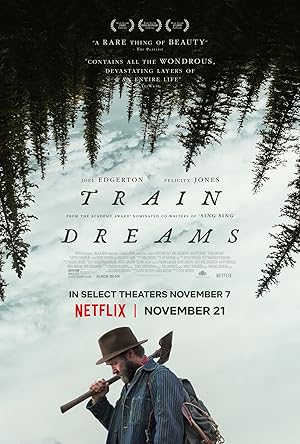
Train Dreams
Plot
Based on Denis Johnson's beloved novella, Train Dreams is the moving portrait of Robert Grainier, a logger and railroad worker who leads a life of unexpected depth and beauty in the rapidly-changing America of the early 20th Century.
Get the Weekly Woke Watchlist
New and trending movies scored for woke bias, preachy messaging, and forced political themes — before you waste your evening.
No spam. One useful email per week.
Overall Series Review
Categorical Breakdown
The film centers on the personal life and grief of a white male protagonist, Robert Grainier, and judges him by his character and resilience, not his identity group. The narrative, however, explicitly includes an incident of unpunished racial violence where a Chinese worker is murdered by white workers, which profoundly haunts the main character. This inclusion acknowledges historical racial injustice without shifting the central focus to a lecture on systemic privilege, placing it above a pure 1/10 score. The casting of actors like Clifton Collins Jr. and Nathaniel Arcand is authentic to the diverse labor force of the time.
The movie is described as an 'ode to a vanishing way of life' and a meditation on American ethos, celebrating the hard work and simple, resilient nature of the American working man. It captures the difficult, hardscrabble life of those who built the railroad and logged the forests, acknowledging their contribution while not romanticizing the brutality of the time. One piece of cultural commentary interpreted the protagonist's suffering as potentially 'attendant to the hubris of being a white person trying to settle down in a big, sprawling country', which introduces a civilizational critique, but this is a critical framing rather than the film's overt theme, suggesting a minor degree of self-hatred in the overall discourse surrounding the work.
The female leads are few: Robert's wife, Gladys, and their daughter, Kate. Gladys is portrayed as a cherished wife and mother whose domestic life is a source of joy and stability for the protagonist. Their home life is presented as warm and loving, celebrating the family unit. The narrative focuses on the protective masculinity of Robert. There is no evidence of a 'Girl Boss' trope, the emasculation of males, or anti-natalist messaging. It is a portrait of traditional, complementary gender roles of the era.
The film is a period drama focused on the life-long journey and nuclear family of a heterosexual man in the early 20th century. There is no information in the available plot or commentary to suggest the inclusion of alternative sexualities, the deconstruction of the nuclear family, or gender ideology, keeping the structure normative and sexuality private to the central couple.
The story is characterized by a central tragic event that profoundly 'rattles his faith in everything'. This indicates the subject of faith and spirituality is present as an internal conflict and source of struggle, rather than being ignored or actively demonized. The movie deals with 'great mysteries of humanity'. It does not frame traditional religion as the root of evil or depict Christian characters as bigots, but centers on an individual's loss of faith and quest for meaning in the face of suffering.
Get the Weekly Woke Watchlist
New and trending movies scored for woke bias, preachy messaging, and forced political themes — before you waste your evening.
No spam. One useful email per week.