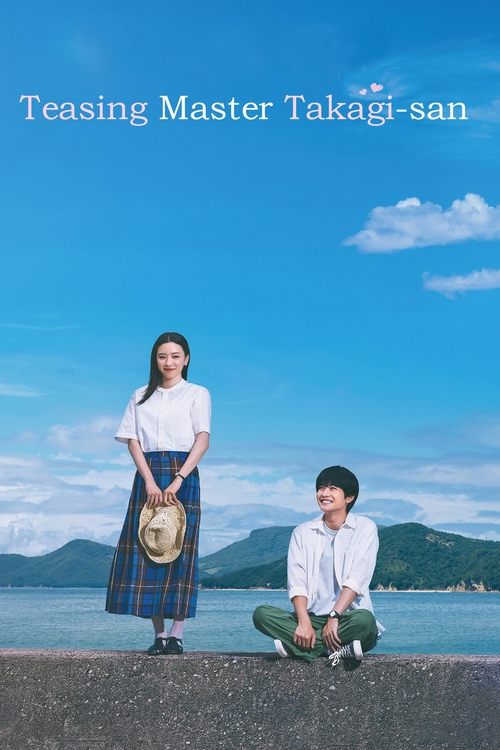
Teasing Master Takagi-san
Plot
Takagi, now grown up, revisits her middle school as a trainer. She encounters Nishikata, her former classmate she used to tease, now a PE teacher there. Their playful dynamic resumes, leading to more interactions between the two.
Get the Weekly Woke Watchlist
New and trending movies scored for woke bias, preachy messaging, and forced political themes — before you waste your evening.
No spam. One useful email per week.
Overall Series Review
Categorical Breakdown
The film operates entirely on a Universal Meritocracy principle, focusing on the characters' individual personalities and relationship. Casting is authentically Japanese for this Japanese story, exhibiting no signs of race-swapping or forced diversity. The narrative avoids any reliance on race, intersectional hierarchy, or the vilification of any demographic.
The movie is set in a beautiful, idyllic Japanese island town and school, showcasing the local culture with warmth and sentimentality. Institutions like the school and the idea of 'home' are portrayed as positive, foundational aspects of the characters' lives and reunion. There is no hostility toward Japanese civilization or the demonization of ancestors; the film exhibits gratitude toward the culture and setting that fostered the main relationship.
Takagi is the dominant personality in the relationship, consistently smarter and more composed than Nishikata, which fits the definition of the 'Girl Boss' trope as she always has the upper hand. However, this dynamic is couched in a traditional, highly affectionate courtship structure, not a lecture on female supremacy. The plot moves toward the ultimate union of a male and female pair. There is no explicit anti-natalism or career-only messaging; the score is low because the dynamic is complementary, though the woman is clearly the intellectual superior and driver of the relationship.
The narrative centers exclusively on the normative male-female pairing of Takagi and Nishikata. The film focuses on a traditional love story and the eventual reunion of the couple. There is a complete absence of centering alternative sexualities, deconstructing the nuclear family, or lecturing on gender ideology, reflecting a normative structure.
As a pure slice-of-life romance, the film does not engage with traditional religion or moral philosophy. The morality depicted is transcendent and traditional—love, purity, and sincerity—avoiding moral relativism. The lack of content on this subject defaults to a low score due to the absence of the high-score criteria.
Get the Weekly Woke Watchlist
New and trending movies scored for woke bias, preachy messaging, and forced political themes — before you waste your evening.
No spam. One useful email per week.